If you use a MacBook for work or travel, you need a multiport adapter that balances power, ports, and size without fuss. This guide cuts through specs and real-world tradeoffs so you can pick a hub that charges at full speed, drives an external display, and handles peripherals—while staying compact enough for your bag. Keep going to compare the best options and which one fits your setup.
Hiearcool 7-in-1 USB-C Hub for MacBook (4K HDMI, 100W PD, USB 3.0, SD/TF Card Reader)

If you need a compact hub that charges your MacBook while driving multiple peripherals, the Hiearcool 7-in-1 is a smart pick—its 100W USB-C PD pass-through keeps your laptop powered during long work sessions while the 4K HDMI and three USB 3.0 ports let you connect a monitor, fast external drives, and SD/TF cards without juggling adapters. You’ll get 4K@30Hz output, three 5Gbps USB-A ports, and SD/TF card reading in a space-grey aluminum body that stays cool. It’s pocketable for travel, supports many Windows and Mac laptops and iPhones, and comes with two-year warranty and solid user ratings.
Best For: users who need a compact, travel-friendly USB-C hub that charges a MacBook while connecting a 4K monitor, multiple USB drives, and SD/TF cards.
Pros:
- 100W USB-C PD pass-through keeps laptops powered during heavy use.
- 4K HDMI output plus three USB 3.0 ports (5Gbps) and SD/TF readers cover common peripherals without extra adapters.
- Compact aluminum design with good heat dissipation and wide device compatibility.
Cons:
- HDMI limited to 4K@30Hz, not ideal for high-refresh displays or smooth 4K gaming.
- Uses a single USB-C connector—may block adjacent ports on some laptops without an extender.
- Performance and compatibility can vary across non-Mac devices and depending on cables/adapters used.
Anker 5-in-1 USB-C Hub with HDMI 4K, USB-C & 2 USB-A 3.0 Ports for MacBook and Laptops

The Anker 5-in-1 USB-C Hub is ideal for MacBook users who need reliable 4K HDMI output and fast USB data transfers in a compact package. You get a 4K@30Hz HDMI port, a 5 Gbps USB-C data port, two 5 Gbps USB-A ports, and an 85W PD-in USB-C charging pass-through (charger not included). It supports USB-C, USB4, and Thunderbolt connections on macOS 12+, Windows 10/11, and ChromeOS, but not Linux. Note the USB-C data port won’t carry video. For iPad charging, plan on a 45W wall charger. Includes a welcome guide and 18-month warranty.
Best For: MacBook and laptop users who need a compact hub for 4K@30Hz HDMI output, fast 5 Gbps USB data transfers, and up to 85W passthrough charging.
Pros:
- Provides 4K@30Hz HDMI output for external displays while remaining compact and portable.
- Two USB-A and one USB-C data ports offer up to 5 Gbps transfer speeds for fast file transfers.
- Supports up to 85W PD pass-through charging (charger not included), sufficient for most laptops.
Cons:
- HDMI limited to 4K@30Hz (not 60Hz), which may be restrictive for smooth high-refresh workflows.
- USB-C data port does not support video output; only the dedicated HDMI port carries display signals.
- Not compatible with Linux and requires a separate charger for passthrough power.
Anker 7-in-1 USB-C Hub Multi-Port Adapter (4K@60Hz HDMI, 85W PD, USB 3.0, USB-C, SD/TF Card Reader)

For power users who need a compact hub that handles high‑res displays and fast charging, Anker’s 7‑in‑1 USB‑C Hub delivers 4K@60Hz HDMI plus up to 85W laptop charging so you won’t compromise screen quality or battery life. You get two USB‑A 3.0 ports and a USB‑C data port (5Gbps) for fast transfers, plus dual SD/TF card slots for photographers. The metal gray chassis is light and compact (5.17 x 1.46 x 0.47 in, 67 g), and compatibility covers MacBooks, Windows, USB4, and Thunderbolt systems with DP Alt Mode. An 18‑month warranty and Amazon returns add peace of mind.
Best For: Power users and creatives who need a compact USB‑C hub that supports 4K@60Hz displays, fast 5Gbps data transfers, and up to 85W laptop charging.
Pros:
- Compact metal design with 4K@60Hz HDMI output for high‑resolution displays.
- Multiple high‑speed ports (two USB‑A 3.0 + USB‑C 5Gbps) plus dual SD/TF card readers for fast transfers.
- Up to 85W PD pass‑through charging (hub supports up to 100W PD input, 85W for laptops) and broad compatibility with MacBook, Windows, USB4, and Thunderbolt systems.
Cons:
- Limited to 85W laptop charging (below full 100W PD capacity some laptops may require).
- Only one HDMI output — not suitable for multi‑monitor setups without daisy‑chaining or additional adapters.
- Metal compact form factor may run warm under heavy simultaneous use.
UANTIN USB-C Hub 7-in-1 Multiport Adapter with 4K HDMI, 100W PD, SD/TF Card Reader and 3 USB-A Ports for USB-C Laptops

Plug this compact 7‑in‑1 hub into your MacBook when you need a simple way to add HDMI, SD/TF card access, three USB‑A ports, and 100W passthrough charging without juggling multiple dongles. You get a 4K@30Hz HDMI output (or smooth 1080p@120Hz), three USB‑A ports with USB 3.0 speeds up to 5Gbps plus USB 2.0 compatibility, and an SD/TF reader for quick media access. The USB‑C PD port supports up to 100W pass‑through to charge your MacBook while powering peripherals. It’s plug‑and‑play, broadly compatible with USB‑C laptops, and backed by responsive customer support.
Best For: power users and content creators who need a compact, plug‑and‑play USB‑C hub to add 4K HDMI, SD/TF card access, multiple USB‑A ports, and 100W passthrough charging to USB‑C laptops.
Pros:
- Expands a single USB‑C port to HDMI (4K@30Hz / 1080p@120Hz), three USB‑A ports (5Gbps USB 3.0), and SD/TF card slots for versatile connectivity.
- Supports up to 100W USB‑C Power Delivery passthrough to charge laptops while powering peripherals.
- Plug‑and‑play compatibility with MacBook and most USB‑C/Thunderbolt laptops and backed by responsive customer support.
Cons:
- 4K output is limited to 30Hz, which may not suit users wanting 4K@60Hz displays.
- All ports share a single USB‑C connection, so heavy simultaneous use could reduce performance or bandwidth for some devices.
- No dedicated Ethernet or optical audio port, so users needing those connections must buy additional adapters.
UGREEN USB C Hub 5-in-1 Multiport Adapter with 4K HDMI, 100W PD, and 3 USB-A Ports

If you frequently juggle a MacBook, external monitor, and multiple USB accessories, the UGREEN 5‑in‑1 hub is a compact workhorse that keeps everything connected. You get a 4K HDMI (30Hz) for video, a 100W USB‑C PD pass‑through (95W usable for charging), one USB‑A 3.0 port (5 Gbps) and two USB‑A 2.0 ports (480 Mbps) for keyboards, mice, and other peripherals. It’s plug‑and‑play across macOS, Windows, and Linux and fits MacBook, iPad Pro, iPhone 16 Pro, XPS and ThinkPad workflows. Avoid plugging or unplugging the PD charger during screencasting or active transfers to prevent data loss.
Best For: power users and professionals who need a compact USB‑C hub to connect a 4K monitor, charge a laptop up to 95W, and attach multiple USB peripherals simultaneously.
Pros:
- Compact 5‑in‑1 design with 4K HDMI and 100W PD pass‑through for single‑cable workstation setups
- High‑speed USB‑A 3.0 port (5 Gbps) for fast file transfers alongside two USB‑A 2.0 ports for keyboards/mice
- Broad plug‑and‑play compatibility with macOS, Windows, and Linux and many USB‑C devices (MacBook, iPad Pro, XPS, ThinkPad)
Cons:
- HDMI limited to 4K at 30Hz, not ideal for 60Hz high‑refresh displays
- PD port delivers 95W effective charging (100W advertised), and plugging/unplugging during transfers can risk data loss
- USB‑A charging via the hub is not recommended, limiting convenience for powering peripherals
Apple USB-C Digital AV Multiport Adapter

Mac users who need a straightforward way to mirror their screen to an HDMI display will appreciate the Apple USB-C Digital AV Multiport Adapter; it combines an HDMI output, a standard USB-A port for peripherals, and a USB-C passthrough for charging so you can run presentations, watch video, and charge simultaneously. You plug it into a USB-C or Thunderbolt 3 port on your Mac or supported iPad, connect an HDMI cable (sold separately), then mirror audio and video to TVs or projectors. The USB-A supports drives, cameras, and iOS syncing, while the USB-C port handles device charging. Requires macOS Mojave 10.14.6/iOS 12.4+.
Best For: Mac and iPad users who need a simple, all-in-one adapter to mirror audio/video to an HDMI display while connecting USB-A peripherals and keeping their device charged.
Pros:
- Simple plug-and-play mirroring to HDMI-enabled TVs or projectors with both audio and video support.
- Includes a USB-A port for flash drives, cameras, and iOS syncing.
- USB-C passthrough lets you charge your Mac, iPad, or iPhone while using the adapter.
Cons:
- Requires an HDMI cable (sold separately), adding to overall cost.
- Occupies a USB-C/Thunderbolt 3 port on your device while in use.
- Requires macOS Mojave 10.14.6 or iOS 12.4 (or later) for optimal compatibility.
Anker 7-in-2 USB-C Hub for MacBook with 4K@60Hz HDMI and Multiple Ports

For users who need high‑resolution external displays and fast charging from a single dongle, the Anker 7‑in‑2 USB‑C Hub is a top pick: it delivers 4K@60Hz HDMI output plus a multi‑function USB‑C port that handles up to 100W charging and 40 Gb/s data, while adding two USB‑A ports and SD/microSD slots without blocking your MagSafe connection. You’ll expand two MacBook USB‑C ports into seven useful ports, including a separate USB‑C data port and HDMI that supports crisp 4K@60Hz (and multi‑function USB‑C up to 5K). It’s compatible with M1/M2 Air and Pro, excludes MacBook Neo, and ships with an 18‑month warranty.
Best For: Power users of MacBook Air/Pro (including M1/M2) who need a compact hub that supports 4K@60Hz video, high‑wattage charging, and multiple legacy ports without blocking MagSafe.
Pros:
- Provides 4K@60Hz HDMI plus a multi‑function USB‑C port with up to 100W charging and 40 Gb/s data, enabling high‑resolution displays and fast charging from one dongle.
- Expands two MacBook USB‑C ports into seven useful ports (additional USB‑C data, two USB‑A, SD and microSD) for versatile connectivity.
- Designed to avoid obstructing MagSafe and includes an 18‑month warranty and customer support.
Cons:
- M1/M2 MacBooks cannot drive dual external displays, so multi‑monitor capability is limited by the laptop, not the hub.
- Not compatible with MacBook Neo, limiting use across some newer or different Mac models.
- Multi‑function USB‑C’s higher capabilities (5K/40 Gb/s) may require specific host support (e.g., Thunderbolt 4) to reach maximum performance.
Hiearcool USB-C 8-in-1 Hub with Ethernet, 4K HDMI, 100W PD, USB 3.0 & SD/TF
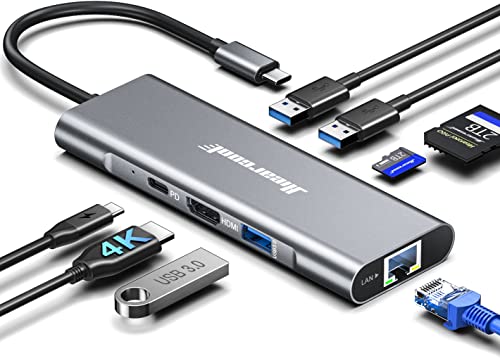
Power users who juggle external displays, wired networks, and multiple peripherals will find the Hiearcool USB-C 8-in-1 hub a solid choice: it delivers 4K@60Hz HDMI, 1Gbps Ethernet, three USB-A 3.0 ports, SD/microSD slots, and 100W pass-through charging in a single compact dongle so you can keep charging while driving multiple devices. You’ll get reliable 4K video for presentations or streaming, stable wired networking for video calls, and ample USB expansion for keyboards, drives, and mice. The SD/TF slots speed media transfer for photographers and students, and the 100W PD keeps your MacBook powered during heavy use.
Best For: Power users and professionals who need single-cable convenience for 4K@60Hz external displays, stable wired networking, fast charging, and multiple USB/SD connections for travel, remote work, or creative workflows.
Pros:
- Provides 4K@60Hz HDMI and 1Gbps Ethernet for high-quality video and reliable wired networking.
- 100W pass-through USB-C Power Delivery lets you charge a laptop while using all ports.
- Three USB-A 3.0 ports plus SD/microSD slots offer ample expansion for peripherals and fast media transfers.
Cons:
- Requires a USB-C host with DisplayPort Alt Mode for full 4K@60Hz output (not all devices support this).
- All ports share bandwidth and power through a single connection, which can limit performance when fully loaded.
- As a compact dongle, it may feel warm under heavy use and offers limited physical port spacing for large USB accessories.
Battony USB-C to HDTV Multiport AV Adapter with 4K Output and USB-C Charging (for MacBook/MacBook Air/iPad Pro)

If you need a compact hub that sends 4K video to a TV or projector while charging your laptop, the Battony USB‑C to HDTV Multiport AV Adapter delivers that in a slim, plug‑and‑play package. You get 3‑in‑1 functionality: HDMI (4K@30Hz), USB‑C charging, and a USB‑A 3.0 port for fast data up to 5Gbps. Its aluminum body helps dissipate heat, and setup requires no drivers. It’s compatible with MacBook/MacBook Air (2015–2019), iPad Pro (2019), and many Windows laptops. The adapter measures 6.61×3.11×0.44 inches, weighs 0.11 lb, and includes a 12‑month warranty.
Best For: users who need a compact, plug‑and‑play USB‑C hub to output 4K video to a TV or projector while simultaneously charging a MacBook, iPad Pro, or compatible Windows laptop.
Pros:
- Supports 4K UHD (3840×2160@30Hz) HDMI output for crisp external displays.
- USB‑A 3.0 and USB‑C ports provide fast data transfer (up to 5Gbps) and pass‑through charging.
- Slim aluminum body with no drivers required and broad device compatibility.
Cons:
- 4K output is limited to 30Hz, which may not suit high‑frame‑rate content or gaming.
- Requires an HDMI 2.0 (or better) cable for full 4K functionality—cable not included.
- Single HDMI and limited port selection may be insufficient for users needing multiple displays or more peripherals.
USB C Hub Adapter for MacBook Pro/Air (8-in-2)

Designed for users who need high-speed video and charging in a compact package, the USB C Hub Adapter (8-in-2) gives MacBook Pro and Air owners a Thunderbolt 3 port with 5K@60Hz and 100W PD plus an HDMI output for 4K@30Hz, making it ideal if you run demanding displays and peripherals simultaneously. You’ll get HDMI, Thunderbolt 3, USB-C, USB 3.0, USB 2.0, SD and Micro SD readers in an aluminum, gray housing. Thunderbolt 3 delivers 40Gbps and 85W output charging; USB 3.0 hits 5Gbps. Dual monitors work except on M1 Macs. It’s lightweight, rated 4.6/5 with a one-year warranty.
Best For: MacBook Pro and MacBook Air users (2016–2025) who need a compact hub that delivers high‑resolution video, fast data transfer, and up to 100W charging for external displays and peripherals.
Pros:
- Provides Thunderbolt 3 (5K@60Hz, 40Gbps) plus HDMI (4K@30Hz) for versatile dual‑monitor setups (except on M1 Macs).
- 100W PD support with 85W output for fast charging while powering peripherals.
- Compact aluminum design with SD and Micro SD readers and high data speeds (USB 3.0 up to 5Gbps).
Cons:
- Dual‑monitor capability limited on M1 Macs (supports only one external display).
- HDMI maxes at 4K@30Hz, which may not satisfy users needing 4K@60Hz from HDMI.
- Not compatible with high‑power USB devices like the Apple USB SuperDrive; avoid using with power‑hungry peripherals.
Factors to Consider When Choosing Macbook Multiport Adapters
When choosing a MacBook multiport adapter, you’ll want to match the port selection and layout to the devices you actually use. Check power delivery capacity, video output specs, and data transfer speeds to make sure the adapter handles charging, external displays, and file moves without bottlenecks. Also consider build quality and materials for durability and heat management.
Port Selection and Layout
How do you pick the right ports and layout for a MacBook multiport adapter? Start by listing the devices you use: external displays, thumb drives, SD cards, and wired peripherals. Choose adapters that include HDMI, USB-A, USB-C, and card readers to match those needs. For displays, pick an HDMI port that supports 4K at 30Hz or 60Hz depending on video smoothness you require. Check USB data speeds—USB 3.0 (up to 5Gbps) for fast transfers, USB 2.0 (480Mbps) for keyboards and mice. Confirm the physical layout avoids blocking adjacent ports so multiple cables fit comfortably and stay accessible on a crowded desk. A compact, well-spaced layout keeps you productive and reduces cable strain.
Power Delivery Capacity
Anyone relying on a multiport adapter needs to check its power delivery (PD) rating—typically 85W–100W—so your MacBook can charge at full speed while you run peripherals. Aim for 100W if you use power-hungry M1/M2 machines or push many ports simultaneously; higher PD minimizes slow charging and reduces risk of unexpected shutdowns. Note some adapters reserve a small buffer (about 5W) to keep data lines stable during charging, which is normal and helps prevent data loss. Before buying, confirm the adapter’s real-world PD output matches your MacBook’s required wattage. If it falls short, you’ll face slowed charging or performance throttling—so match specs to your laptop, not just marketing claims.
Video Output Specs
If you want smooth, high-resolution external displays, pay close attention to an adapter’s video specs—especially the HDMI or DisplayPort version and whether it supports 4K at 60Hz or only 30Hz. Pick HDMI 2.0 or DisplayPort-capable adapters for fluid motion and full 4K@60Hz; 30Hz feels choppy for scrolling, video, or gaming. If you need multiple screens, confirm dual-monitor support and that both outputs can handle 4K—some MacBook chips limit you to a single external display. Also match the adapter to your monitors’ inputs so you’re not bottlenecked by a legacy port. Finally, make sure the adapter still provides adequate PD charging while driving high-resolution video so your MacBook stays powered during use.
Data Transfer Speeds
Video output matters, but you’ll also want to check data transfer speeds—especially if you move large files, run external storage, or connect high-bandwidth peripherals. USB ports vary widely: USB 2.0 tops out at 480 Mbps, while USB 3.0 can reach about 5 Gbps, dramatically cutting transfer times. For pro workflows, prefer adapters with Thunderbolt 3 at up to 40 Gbps or USB4 support for even greater throughput and versatility. Inspect each port’s capability—some handle video, others prioritize raw data. Also confirm the adapter’s aggregate bandwidth so your combined devices don’t exceed its limit, which would throttle performance. Match adapter specs to your fastest drive or peripheral to avoid bottlenecks and preserve full transfer speeds.
Build Quality and Materials
Materials and construction matter because they determine how long an adapter will last and how well it handles regular use. You should favor adapters built from high-quality materials like aluminum; it’s durable and helps dissipate heat during heavy use. Pick a compact, lightweight model so you can slip it into your bag without extra bulk—slim profiles improve portability and everyday convenience. Inspect connection points for sturdiness to reduce wear on ports and extend the adapter’s lifespan. Also check for certifications or safety ratings that confirm the adapter meets performance and electrical standards; those indicate reliability and protect your MacBook. Balancing solid construction with a slim, portable design gives you both durability and convenience.
Compatibility and OS Support
Because MacBooks vary across generations and ports, you’ll want an adapter explicitly compatible with your model and macOS version to avoid missing features or reduced performance. Check compatibility lists and confirm support for macOS 12 or later so drivers and passthrough features work correctly. Prioritize adapters with USB-C and Thunderbolt connections for higher data rates and lower latency. If you plan dual monitors, verify the adapter’s dual-display capability and any resolution or refresh-rate limits tied to your MacBook’s GPU and ports. Also confirm power delivery specs: ascertain the adapter can supply adequate wattage to charge your MacBook while multiple ports are active. Matching adapter specs to your specific MacBook and macOS prevents frustrating limitations.
Thermal Management Design
You’ve checked compatibility and power delivery, but thermal behavior can make or break real-world performance when you run multiple ports at once. Pay attention to housing materials—aluminum or similarly conductive metals pull heat away from internal components, so adapters stay cooler under sustained loads. Look for visible vents or advertised heat sinks; those features improve airflow during heavy tasks like 4K video output or simultaneous data transfers. Good thermal design prevents throttling, helping charging speeds and transfer rates remain consistent. It also reduces the risk of component failure or fire hazards caused by excessive heat. If you plan long sessions with many ports active, prioritize adapters that explicitly mention passive or active cooling strategies in their specs.
Size and Portability
Portability matters as much as ports: you’ll want a compact, lightweight adapter that slips into a bag or sleeve without adding bulk. Pick a slim-profile unit with an aluminum build — it keeps weight down, resists wear, and helps dissipate heat from busy ports. Check dimensions before you buy so the adapter won’t obstruct adjacent MacBook ports or hang awkwardly when plugged in. Aim for a design that balances functions and size: a multiport hub should give you HDMI, USB-A, SD, and passthrough charging without becoming a bulky brick. That way you can carry one adapter for office, café, or travel use and trust it to fit neatly alongside your charger, mouse, and cables.