If you need blazing network speeds and a clean, powerful workstation, these top 10 MacBook docks with 10GbE are worth your attention. They pack high-watt PD, multiple displays, and rugged port sets so you can transfer massive files and run demanding workflows without bottlenecks. I’ll walk you through the best options and what really matters when picking one—so you can choose the right dock for your setup.
iVANKY FusionDock Ultra 26-in-1 Thunderbolt 5 Docking Station for Mac (Dual Chips, 10GbE, Quad 6K/Triple 8K, 120Gbps, 240W)

If you need a dock that turns a Mac into a pro-grade workstation, the iVANKY FusionDock Ultra is for you: it pairs dual Thunderbolt 5 chips and a built-in 10GbE port to deliver the bandwidth and low-latency networking creatives, developers, and power users rely on for multi‑display 6K/8K setups, high‑speed file transfers, and seamless external device chaining. You’ll get quad 6K@60Hz or triple 8K@60Hz display support, 80–120Gbps transfer speeds, 140W passthrough to your Mac, and an extra 45W PD port. The dock adds four TB5 downstream ports, Toslink, SD 4.0, smart cooling, and a 24‑month warranty.
Best For: Mac power users and creative professionals who need a pro-grade docking solution for multi-6K/8K displays, high-speed networking, and extensive peripheral connectivity.
Pros:
- Dual Thunderbolt 5 chips with quad 6K@60Hz / triple 8K@60Hz support provides exceptional multi‑display performance for demanding macOS workflows.
- Built‑in 10GbE, 80–120Gbps data rates, and four TB5 downstream ports enable fast file transfers and low‑latency networking for studios and dev environments.
- Robust thermal design (NTC‑controlled fan, copper heat sinks, floating chassis) plus 140W passthrough and 45W PD for reliable power and device charging.
Cons:
- Designed exclusively for Mac (M1–M5 Pro/Max), so compatibility with other systems is limited or unsupported.
- High-end feature set and dual‑chip design likely make the unit larger and more expensive than basic docks.
- Some users may find the advanced display and bandwidth capabilities overkill for everyday or casual use.
CalDigit TS5 PLUS Thunderbolt 5 Dock (20-Port, 140W Host Charging, 10Gb Ethernet, Dual USB Controllers)

Power users who need desktop-class connectivity will appreciate the CalDigit TS5 PLUS for its combination of Thunderbolt 5 bandwidth and a built‑in 10GbE port—perfect for MacBook Pros that demand fast file transfers to NAS and multiple high‑resolution displays. You get 20 ports including three Thunderbolt 5 (80Gb/s), 10 USB ports with dual controllers, DisplayPort 2.1, SD/microSD UHS‑II readers, three audio jacks, and native 10GbE. The 140W host charge and 330W PSU keep power‑hungry MacBook Pros topped up while downstream ports offer 36W. Dual‑display support, Bandwidth Boost to 120Gb/s, aluminum cooling, and USB4/Thunderbolt compatibility make it a pro‑grade dock.
Best For: Power users and creative professionals who need desktop-class Thunderbolt 5 bandwidth, native 10GbE networking, and multi‑display support for high‑resolution/ high‑refresh workflows on MacBook Pros and compatible Thunderbolt/USB4 hosts.
Pros:
- Comprehensive 20‑port connectivity including three Thunderbolt 5 ports (80Gb/s), DisplayPort 2.1, SD/microSD UHS‑II readers, and 10Gb Ethernet for fast NAS/file transfers.
- 140W host charging (with 330W PSU) keeps power‑hungry 16” MacBook Pros topped up while downstream ports supply up to 36W for accessories.
- Dual USB controllers prevent bandwidth bottlenecks across 10 USB ports; aluminum chassis and Bandwidth Boost (up to 120Gb/s) optimize performance and cooling.
Cons:
- Maximum performance requires Thunderbolt 5 or USB4 v2 hosts; not compatible with non‑Thunderbolt devices.
- Windows users must manually install a 10GbE driver for full Ethernet functionality.
- Large aluminum chassis needs ample clearance and ventilation, which may be cumbersome on crowded desks.
Anker Prime TB5 14-in-1 Thunderbolt 5 Docking Station

For MacBook users who need blazing transfers and lots of ports, the Anker Prime TB5 is a clear choice — its Thunderbolt 5 upstream delivers up to 140W charging and 120Gbps bandwidth so you can charge fast and move huge files in seconds. You get 14 ports: two TB5 downstream, two USB‑C, three USB‑A, SD/TF readers, HDMI 2.1/DP2.1, audio, and 2.5GbE. It transfers a 150GB file in ~25 seconds, supports up to dual 8K@60Hz on compatible systems, and uses active cooling to stay stable under load. It ships with cables, a 24‑month warranty, and solid customer ratings.
Best For: MacBook and Thunderbolt‑equipped laptop users who need extremely fast transfers, high‑wattage charging, and a wide array of ports for multi‑display and peripheral-heavy workflows.
Pros:
- Thunderbolt 5 upstream with up to 140W PD 3.1 charging and 120Gbps bandwidth for rapid charging and very fast file transfers (150GB in ~25s).
- Extensive 14‑in‑1 port selection including two TB5 downstream, multiple USB‑C/A, SD/TF readers, HDMI 2.1/DP2.1, audio jack, and 2.5GbE for broad connectivity.
- Active cooling and support for up to dual 8K@60Hz (on compatible systems) keep performance stable under heavy load.
Cons:
- Full capabilities (dual 8K, 120Gbps) require Thunderbolt 5/compatible host hardware—limited benefit on older laptops.
- Relatively bulky and heavier than simpler docks (2.4 lbs), which may reduce portability.
- High-end feature set and included cables may come at a premium compared with basic USB‑C hubs.
Anker Nano 13-in-1 USB-C Laptop Docking Station with Triple Display and 100W PD

Mac users who need a compact yet powerful dock will appreciate the Anker Nano 13-in-1, which pairs a detachable 6-in-1 mobile hub with a full docking station to deliver triple displays, 10 Gbps USB-C transfers, and up to 100W laptop charging. You get two HDMI, one DisplayPort, and multiport USB-C/USB-A connectivity, plus Ethernet, audio and SD/TF slots for a complete desktop setup. It supports up to 4K external displays (macOS mirrors content), accepts 140W max adapter input, and measures compactly in black. With solid customer ratings and return support, it’s a practical, portable hub-and-dock solution.
Best For: Mac and Windows users who need a compact, portable dock that provides triple-display support, fast 10 Gbps data, and up to 100W laptop charging for a full desktop setup.
Pros:
- Detachable 6-in-1 mobile hub plus full 13-in-1 dock offers flexible mobile and desktop use.
- Triple-display support with two HDMI and one DisplayPort and up to 4K resolution (noting macOS mirrors external displays).
- High-speed USB-C data (10 Gbps), Gigabit Ethernet, SD/TF slots, and up to 100W power delivery.
Cons:
- macOS may mirror external displays rather than extend, limiting multi-monitor workflows on Macs.
- Requires a high-wattage (up to 140W) power adapter for maximum charging and full functionality, which may not be included.
- Relatively compact but still adds ports/cables and may be bulkier than single-piece mobile-only hubs.
Anker 8-in-1 USB-C Laptop Docking Station with Dual 4K HDMI, 1 Gbps Ethernet, 85W PD & SD Card Reader

If you need a compact hub that covers everyday ports and charges a laptop quickly, the Anker 8‑in‑1 is a solid pick—its 85W pass‑through PD and dual 4K HDMI make it ideal for professionals who juggle video conferencing and external displays while keeping a single cable on their desk. You get two HDMI ports (4K@60Hz single, 4K@30Hz dual), a 1 Gbps Ethernet jack, SD/microSD slots, two USB‑A ports and a USB‑C PD‑IN. It works with USB‑C, USB4 and Thunderbolt hosts on macOS and Windows (not Linux). Note: charger and C‑to‑C cable aren’t included.
Best For: Professionals and remote workers who need a compact, single‑cable docking solution that charges laptops up to 85W while driving one or two external 4K displays and providing Ethernet and card-reader connectivity.
Pros:
- Supports single 4K@60Hz or dual 4K@30Hz HDMI outputs for flexible multi-monitor setups.
- 85W USB‑C Power Delivery pass‑through lets you charge most laptops while using the hub.
- Includes Gigabit Ethernet and SD/microSD slots plus two USB‑A ports for everyday expansion.
Cons:
- Charger and USB‑C cable are not included, and an appropriate 100W PD charger is required for full 85W passthrough.
- Dual 4K is limited to 30Hz, which may be insufficient for smooth motion or gaming on both monitors.
- Not compatible with Linux (supports Windows, macOS, ChromeOS, USB4 and Thunderbolt hosts).
Anker 13-in-1 USB-C Laptop Docking Station (Triple Display, 85W Charging)

Power users who need lots of ports and fast wired networking will like the Anker 13-in-1 PowerExpand, which combines 10 Gbps USB-C data, an Ethernet jack, and triple-display support with up to 85W charging so you can dock a MacBook and multiple peripherals without juggling adapters. You get two HDMI ports, one DisplayPort, four USB ports (10 Gbps USB-C, 5 Gbps USB-A), SD/microSD slots, a 3.5mm audio jack, and an 85W PD port plus an 18W USB-C. It supports three 1080p@60Hz displays, though macOS limits you to mirrored SST. A 135W adapter and 18-month warranty round it out.
Best For: Power users who need a single hub to connect multiple monitors, fast wired Ethernet, and high-speed USB peripherals while providing up to 85W laptop charging.
Pros:
- Triple-display support (2x HDMI + 1x DisplayPort) for up to three 1080p@60Hz monitors.
- High-speed data and networking with a 10 Gbps USB-C port, 5 Gbps USB-A ports, and an Ethernet jack.
- Generous power delivery (85W PD) plus included 135W adapter and an 18-month warranty.
Cons:
- macOS/iPadOS limited to mirrored output (SST), preventing independent multi-monitor setups on Apple devices.
- Bulkier/weighted than simpler hubs (dimensions 3.5 x 1.6 x 4.9 in, 13.12 oz), which may reduce portability.
- Total USB ports limited to four, which might require an additional hub for users with many USB-A devices.
TobenONE MacBook USB-C Docking Station (Dual 4K@60Hz, 7 USB Ports, 100W GaN)
The TobenONE dock is a great fit if you want a compact, all-in-one hub that drives two 4K@60Hz displays while delivering 100W pass-through charging. You get dual HDMI for crisp dual-monitor setups, seven USB ports including a 20W fast-charge USB-C for phones, and a 2.5Gbps Ethernet port that outpaces Gigabit for large transfers, streaming, and editing. It’s small (4.7 x 2.9 x 2.3 in), light (351 g), and uses GaN for efficient power. It supports most Intel and Pro/Max MacBooks (single external display on M1/M2/M3 non-Pro/Max), includes a 2-year warranty, and scores highly in reviews.
Best For: professionals and power users with MacBooks who need a compact single-cable dock that drives two 4K@60Hz monitors, provides high-speed 2.5GbE and 100W pass-through charging for productivity workflows.
Pros:
- Dual HDMI outputs supporting 4K@60Hz for true dual-monitor setups (on supported MacBooks).
- 100W GaN pass-through charging plus seven USB ports and a 20W fast-charge port for peripherals and mobile devices.
- 2.5Gbps Ethernet significantly faster than Gigabit for large file transfers, streaming, and editing.
Cons:
- Not compatible with Windows laptops and limited to one external monitor on M1/M2/M3 non‑Pro/Max MacBooks.
- Compact housing may get warm under heavy load despite GaN efficiency.
- Only HDMI video outputs (no DisplayPort) and may require adapter cables for some monitor setups.
PULWTOP USB-C Docking Station for MacBook Pro/Air (Dual 4K@60Hz, HDMI, PD, Ethernet, USB)
For professionals who need a tidy desktop and high-bandwidth ports, the PULWTOP USB-C Docking Station doubles as a sturdy laptop stand while giving you dual 4K@60Hz HDMI output and multiple 10Gbps USB ports for fast transfers. You get an 11-in-1 hub: 2x 4K HDMI, 2x USB-C 10Gbps, 1x USB-A 10Gbps, USB-A 2.0, SD/MicroSD, 100W PD IN, and RJ45 Gigabit Ethernet. It supports MacBook Pro 14/16 (M3–M5) and Air (M4–M5) plus older Intel models, but not M1/M2, MacBook Neo, or Windows. Use the closed-lid stand, a 65W+ adapter, and note cases won’t fit.
Best For: Professionals and creative users with MacBook Pro/Air (M3–M5 or compatible Intel models) who want a compact laptop stand plus an 11‑in‑1 dock for dual 4K@60Hz displays, fast 10Gbps USB transfers, and wired Ethernet.
Pros:
- Dual 4K@60Hz HDMI plus 10Gbps USB‑C/A ports enable high‑bandwidth multi‑monitor and fast data workflows.
- Integrated laptop/tablet/phone holder doubles as a sturdy closed‑lid stand to declutter the desktop.
- 100W PD input and Gigabit Ethernet provide reliable charging and wired network connectivity.
Cons:
- Not compatible with M1/M2 Macs, MacBook Neo (A18 Pro 2026), or Windows laptops.
- Requires an external 65W+ power adapter (not included).
- Closed‑lid stand won’t fit laptops with cases and is limited to closed‑lid operation.
TobenONE MacBook USB-C Docking Station Dual 4K with 100W Power Adapter

If you need a compact hub that drives two true 4K displays and charges your MacBook reliably, TobenONE’s dock is a solid pick—especially for MacBook Pro users who want a vertical stand and 100W adapter in one unit. You get dual 4K@60Hz via two HDMI ports (HDMI2 mirrors to VGA), plus VGA, five USB, SD/microSD, RJ45, PD 3.0, and audio. The included 100W adapter supplies up to 87W to your MacBook for fast charging. It’s tailored to MacBook Pro (2016–2024) and Air (2018–2025); check M1–M3 models for single-screen limits.
Best For: MacBook Pro users needing a compact dock that supports dual true 4K@60Hz displays, provides a vertical stand, and offers high-power charging for a tidy desktop setup.
Pros:
- Drives dual 4K@60Hz displays via two HDMI ports (with HDMI2 mirrored to VGA) — great for video editing and presentations.
- Includes a 100W power adapter delivering up to 87W PD output to charge MacBooks quickly while connected.
- Combines docking station and vertical stand to save desk space and organize cables, plus a wide array of ports (VGA, 5×USB, SD/microSD, RJ45, audio).
Cons:
- M1–M3 MacBook models support only single-screen expansion, limiting dual-4K use on those machines.
- Compatibility limited to MacBook Pro (2016–2024) and MacBook Air (2018–2025); other laptops may not be supported.
- HDMI2 mirrors to VGA (rather than providing independent outputs), which reduces multi-monitor flexibility.
Plugable Thunderbolt 4 Dock (TBT-UDM) for M4/M5 MacBook Air & Pro
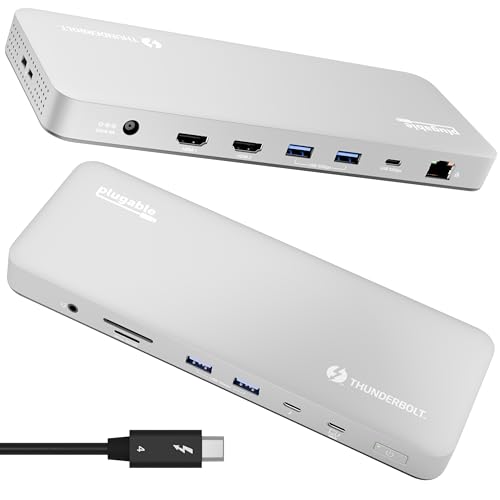
Plugable’s Thunderbolt 4 Dock (TBT-UDM) is a great pick when you need a reliable, compact hub that powers dual 4K 60Hz displays and delivers 10GbE-class wired networking for M4/M5 MacBook Air and Pro users. You get an aluminum-clad dock with 13 ports: Thunderbolt 4 (40Gbps), USB-C, four USB-A, SD/microSD UHS-II, Ethernet, and audio, plus 100W charging. It supports dual external displays on M4/M5, Pro/Max M-series, and M3 in clamshell, while base M1/M2 are limited. It’s driverless, works with Windows Thunderbolt 4/USB4, and includes lifetime North American support.
Best For: Power users and creative professionals with M4/M5 MacBook Air or Pro who need a compact, reliable dock for dual 4K60 displays, high-speed peripherals, and 100W charging.
Pros:
- Supports dual 4K 60Hz HDMI displays on M4/M5 and Pro/Max M-series (driverless) for high-resolution multi-monitor setups.
- Robust connectivity with 13 ports including Thunderbolt 4 (40Gbps), USB-C, four USB-A, SD/microSD UHS-II, Ethernet, and 3.5mm audio plus 100W charging.
- Designed for reliability and ease of use (driverless) with lifetime North American support ideal for IT deployments and home offices.
Cons:
- Dual-display support is limited on base M1/M2 Macs (single external display) and requires clamshell mode for dual displays on base M3.
- Aluminum-clad compact design may limit port spacing for bulky connectors or adapters.
- Higher-end functionality (dual 4K60, 10GbE-class networking) requires Thunderbolt 4/USB4-equipped hosts and may not be fully utilized on older systems.
Factors to Consider When Choosing Macbook Docking Stations With 10GBE
When choosing a 10GbE dock, you’ll first match the required network speed to your workflows so you’re not paying for bandwidth you won’t use. Check compatibility with your MacBook model, and balance the number of ports and power delivery to support your peripherals and charging needs. Also consider thermal performance and build quality, plus support for current and emerging standards to keep the dock useful longer.
Required Network Speed
A 10GbE docking station can transform your MacBook’s networking, so make sure your workflow actually needs that extra bandwidth before investing. If you handle large file transfers, high‑res video editing, or heavy cloud workflows, you’ll notice dramatic improvements versus Gigabit Ethernet. To get full 10GbE speeds, both the dock and the device at the other end must support 10GbE standards; otherwise you’ll be limited to lower throughput. Check your switches, routers, and NAS—your local network must also be 10GbE capable. Remember cable quality and run length matter: use appropriate Cat6a/Cat7 or fiber and keep distances within spec. Finally, factor in network congestion and simultaneous users, since shared loads can erode peak performance.
Compatibility With Macbooks
Now that you know your network needs, make certain the dock itself matches your MacBook. Check that the dock explicitly supports your model and chip family—M1, M2, M3, and M4/M5 compatibility matters because some docks only target Intel Macs. Verify macOS version compatibility too; firmware or driver limits can affect display output and features. Confirm the dock handles the number of external monitors your workflow requires, since certain MacBooks restrict multi‑display setups. Ascertain the station includes 10GbE so you get the high network throughput you need for large file transfers and low-latency tasks. Finally, look for Power Delivery support with sufficient wattage—typically 100W–140W—so the dock can charge your MacBook while powering peripherals.
Port and Power Balance
While weighing 10GbE performance, make sure your dock’s ports and power delivery match your workflow so you don’t bottleneck speed or run out of juice. You’ll want a mix of USB-A, USB-C, and HDMI to cover legacy peripherals and multiple displays, plus Thunderbolt 5 or USB-C 3.2 ports for sustained high-speed transfers at or above 10Gbps. Prioritize docks that deliver 100W–140W PD so your MacBook stays charged while powering drives and monitors. Look for SD card slots and audio jacks to reduce dongles and keep your desk tidy. Balance means enough high-bandwidth ports for simultaneous transfers without starving power to attached devices. Skip docks that force trade-offs between connectivity and adequate charging.
Thermal and Build Design
Think about heat management as part of the dock’s performance—you’ll want designs that move heat away from sensitive components so your 10GbE throughput and connected displays won’t throttle. Check for intelligent fans and copper heat sinks; these actively pull heat out during sustained loads. A floating chassis or raised feet improves airflow under the unit, reducing internal temperatures without loud cooling. Metal housings, especially aluminum, help dissipate heat and add durability, so you’ll get both thermal benefits and a sturdy feel. If you plan to drive multiple high‑resolution monitors or heavy transfers, prioritize docks with advanced cooling systems. Finally, leave adequate clearance around the dock for ventilation—tight spaces defeat even the best designs.
Future‑proofing and Standards
Because standards and port capabilities keep advancing, you should prioritize docks that support current and emerging protocols—like USB4, Thunderbolt 4 (and ideally Thunderbolt 5 readiness) and 10GbE—so your investment stays useful as you upgrade laptops and peripherals. Look for docks that combine 10GbE with multiple high‑bandwidth ports so you can run triple 8K or quad 6K displays, transfer massive files, and stream high‑res video without bottlenecks. Check USB Power Delivery levels to guarantee fast charging for your MacBook while maintaining performance. Check vendor firmware update policies and modular designs that add new ports or NICs later. Choosing standards-forward, well-supported docks reduces replacement frequency and keeps your workstation responsive as peripherals and network demands evolve.