If you want a single reader that can move files between cameras, phones, tablets, and laptops, this SD Card Reader for iPhone iPad Mac is built around that job.
This review focuses on whether its broad port support and plug-and-play design make it a smart buy.
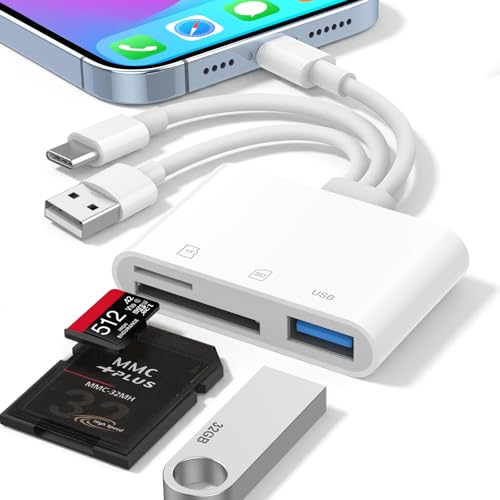
SD Card Reader for iPhone iPad Mac Review Summary
This is a strong fit for buyers who want one compact adapter that covers Lightning, USB-C, and USB-A without juggling extra dongles.
It makes the most sense for photographers, travelers, and anyone who regularly imports camera files into an iPhone, iPad, Mac, or USB-C phone.
The appeal is straightforward: the listing emphasizes MFi certification, native app support, dual card slots, and OTG support from the built-in USB-A female port.
That combination makes it more versatile than a basic single-port reader, especially if you move media between mixed devices and memory cards.
The main tradeoff is that this is still a utility accessory, not a premium workstation device.
You are buying convenience, compatibility, and portability, not a feature-heavy hub with display output or advanced workstation functions.
Review Scorecard
| Category | Score | Buyer-focused rationale |
|---|---|---|
| Device compatibility | 9/10 | Built-in Lightning, USB-C, and USB-A male ports cover a wide range of Apple devices, Macs, and computers. |
| Card handling | 8/10 | Dual SD and Micro SD slots support common camera and phone cards up to 1TB. |
| Ease of use | 9/10 | The listing says no app or driver is required, which keeps setup simple. |
| Transfer practicality | 8/10 | Bidirectional transfer support is a useful fit for backup, editing, and sharing workflows. |
| Portability | 8/10 | A single all-in-one adapter is easier to carry than a stack of separate readers. |
| OTG usefulness | 7/10 | The USB-A female port adds flexibility, but its usefulness depends on the accessory you want to connect. |
| Overall buyer value | 8/10 | It solves a real compatibility problem for mixed-device users without much setup overhead. |
Key Features and Specifications of SD Card Reader for iPhone iPad Mac
This reader is designed as a 3-in-1 accessory with built-in Lightning, USB-C, and USB-A male connectors.
That matters because it removes the need to keep separate readers around for older iPhones, newer USB-C devices, and standard USB-A computers.
The listing also says it is Apple MFi certified, which is important for buyers who want a clearer compatibility signal on the Lightning side.
For people who have been burned by flaky third-party adapters, that is one of the stronger trust cues in the product data.
Card support is centered on SD and Micro SD formats, including SD, SDHC, SDXC, Micro SD, Micro SDHC, and Micro SDXC.
The stated capacity support goes up to 1TB, which is enough for most consumer and enthusiast camera libraries.
The stated file system support includes exFAT and FAT32.
That makes the reader more practical for large camera files, while the FAT32 note still matters because single files over 4GB are a common edge case for video users.
The USB-A female OTG port adds another layer of flexibility.
The listing says you can connect flash drives, digital cameras, keyboards, and mice, though it also notes that printers are not supported and that AssistiveTouch should be enabled for mouse use.
Other useful listing claims include:
- Plug-and-play operation with no app or driver required
- Native Files or Photos app support for import and viewing
- Fast bidirectional file transfer for photos, videos, and documents
- Compatibility with Lightning and USB-C iPhones, iPads on iOS 9.2+, Macs, and USB-A laptops
- Designed for travel and outdoor photography workflows
Pros and Cons of SD Card Reader for iPhone iPad Mac
Pros
- One adapter covers multiple connection types, which reduces clutter.
- Dual card slots make it more useful than a single-format reader.
- MFi certification is a meaningful compatibility signal for Apple users.
- No app or driver requirement keeps the workflow simple.
- Bidirectional transfer support helps with backup and file management.
- USB-A OTG support broadens the accessory’s utility beyond memory cards.
Cons
- It is still a utility accessory, so there is no premium build or workstation-style feature set in the listing.
- OTG use is helpful, but it adds complexity if you only want a simple card reader.
- Printer support is explicitly excluded, which limits some peripheral use cases.
- The product’s value depends heavily on how often you move files across different device types.
Who Should Buy SD Card Reader for iPhone iPad Mac?
Buy this if you regularly pull photos or videos off SD cards and want to move them across Apple and non-Apple devices without extra adapters.
It is especially sensible for photographers who need quick imports into an iPhone or iPad on location, then later want to continue editing on a Mac or laptop.
It also makes sense for travelers and field workers who want a compact all-in-one reader that can handle common card formats and standard computer ports.
The listing’s emphasis on plug-and-play use is a good fit for people who do not want to manage apps, drivers, or multiple dongles.
You should probably skip it if you only ever use one device type and never touch memory cards outside a single laptop or phone.
In that case, a simpler one-port reader may be enough, and the extra connector options would not add much.
It is also less compelling if your workflow depends on advanced dock features, external display support, or specialized workstation connectivity.
This product is about practical file access, not expanding a desk setup.
File Transfer Workflow With SD Card Reader for iPhone iPad Mac
Importing Camera Media
The strongest use case is straightforward camera import.
The listing supports SD and Micro SD formats, so it is clearly aimed at common photo and video workflows where cards move from a camera into a phone, tablet, or computer for review and editing.
Moving Files Between Devices
Because it includes Lightning, USB-C, and USB-A male ports, the reader is well suited to mixed-device file movement.
That is valuable when your main editing device changes depending on where you are working, since the same accessory can follow the file instead of forcing you to change accessories.
OTG Accessory Use
The USB-A female port is what makes this more than a basic card reader.
If you have a compatible accessory such as a flash drive, keyboard, or mouse, the reader can function as a small bridge for simple OTG tasks, although that is clearly secondary to card transfer.
Why Plug-and-Play Matters
The no-app, no-driver claim is not flashy, but it is one of the most useful parts of the product.
In real buyer terms, it reduces setup friction and makes the reader more approachable for people who want a quick import rather than a new workflow.
Alternatives to SD Card Reader for iPhone iPad Mac
If you want a simpler Apple-focused option, consider a Apple USB-C to SD Card Reader for a more minimal setup.
If you need broader accessory support and do not mind a different form factor, look at a UGREEN SD card reader or a Anker SD card reader.
If your priority is one hub-like accessory for mixed devices, a uni card reader is another credible line to compare.
For photographers who mainly want camera-to-computer transfers, a SanDisk card reader is also worth checking because the brand is widely associated with storage accessories.
Is SD Card Reader for iPhone iPad Mac Worth It?
Yes, if your main problem is compatibility across Lightning, USB-C, and USB-A devices, this reader looks worth considering.
The combination of MFi certification, dual card slots, plug-and-play use, and OTG flexibility makes it a practical purchase for people who move media often.
It is not the most specialized accessory on the market, but it does not need to be.
For buyers who want one compact reader that handles common camera cards and works across multiple Apple and computer setups, this is a sensible buy.