If you want a serious graphics boost for your Mac mini, these external GPU enclosures give you power, ports, and flexibility without swapping machines. You’ll find compact docks, rackmount solutions, and Thunderbolt 3–5 expansion chassis that handle full‑size GPUs, fast storage, and robust cooling. I’ll walk through ten top options and the key factors to pick the right one — but first, consider how you’ll use the extra GPU horsepower.
Mini eGPU Enclosure Compatible with Thunderbolt 3/4 and USB4 (External GPU Dock Station)

If you need a compact, Thunderbolt 3/4- and USB4-ready eGPU that doubles as a dock, this mini enclosure is ideal—especially if you want 85W PD charging, daisy-chaining, and support for standard NVIDIA/AMD PCIe cards while keeping your Mac Mini setup tidy. You plug it into a TB3/TB4 or USB4 port, add a compatible PCIe card and appropriate SFX/ATX/DC power, then enjoy GPU acceleration plus an extra USB-A and a second TB3 port. Check your system’s Device Manager for Thunderbolt/USB4 support before buying. It ships with cable and manual; card and PSU aren’t included.
Best For: users with Thunderbolt 3/4 or USB4-equipped laptops or compact desktops (like Mac Mini) who want a portable eGPU/dock solution with 85W PD, daisy-chaining, and support for standard NVIDIA/AMD PCIe cards.
Pros:
- Compact dual-role design: functions as both an eGPU enclosure and a Thunderbolt hub (extra TB3 port + USB-A).
- Broad PSU compatibility (SFX/ATX/DC/FLEX) and 85W PD passthrough for laptop charging.
- JHL7440 controller ensures stable Thunderbolt/USB4 connectivity and daisy-chaining support.
Cons:
- Requires user-supplied GPU and appropriate power supply; some DIY assembly and driver/configuration knowledge needed.
- Not compatible unless the host shows Thunderbolt/USB4 support in Device Manager (pre-check required).
- DC power option limited to PCIe cards that don’t need external auxiliary power; full-power GPUs may need larger ATX/SFX PSUs.
Sonnet RackMac mini 2U Rackmount Enclosure for Mac mini (2024+)

The Sonnet RackMac mini 2U is best for professionals who need to rack-mount one to three Mac minis in tight spaces while keeping them cool and accessible. You’ll get a compact, rugged steel 2U enclosure that fits standard 19-inch racks and shallow cases with a 5.2-inch mounting depth. Front-to-back airflow keeps your Mac minis running efficiently, even when stacked with other gear. Front panel buttons let you power units without wrestling cables, and front/back port access maintains connectivity. Rubber cushions secure Macs during transport, making this ideal for mobile setups, server rooms, and any space-conscious workflow.
Best For: Professionals and IT managers who need to securely rack one to three Mac minis in tight or mobile rack spaces while maintaining cooling, accessibility, and transport protection.
Pros:
- Compact 2U rugged steel design fits standard 19″ racks and shallow 5.2″ mounting-depth cases.
- Front-to-back airflow and exposed front/back ports keep units cool and fully accessible.
- Front-panel power buttons and rubber cushions for secure transport simplify operation and mobility.
Cons:
- Designed specifically for 2024+ Mac minis, so older Mac mini models may not be supported.
- Limits you to up to three single-node Mac minis—no internal expansion for larger server needs.
- Rackmount solution adds fixed rack space and weight compared with standalone deployment.
OWC miniStack STX Upgradable Storage Enclosure and Thunderbolt Hub

For Mac mini users who need massive, upgradable storage and a versatile Thunderbolt hub in one compact unit, the OWC miniStack STX fits the bill. You get an upgradable enclosure that accepts 3.5″, 2.5″ drives and M.2 NVMe, plus three Thunderbolt ports and four USB-C ports to chain devices and run two displays. It delivers up to 96W notebook charging and real-world speeds to about 770MB/s, making 4K editing and backups smooth. The aluminum case uses an internal heatsink and fan for quiet cooling, and OWC backs drives with a 3-year warranty and the enclosure for one year.
Best For: Mac mini users and creative professionals who need high-capacity, upgradable local storage plus a compact Thunderbolt hub for chaining devices and powering 4K workflows.
Pros:
- Upgradable enclosure supporting 3.5″, 2.5″ drives and M.2 NVMe for flexible, high-capacity storage expansion.
- Three Thunderbolt ports and four USB-C ports (plus USB-A via adapter) enable device chaining and dual-display setups while providing up to 96W notebook charging.
- Solid performance (real-world speeds up to ~770 MB/s) in a quiet aluminum chassis with internal heatsink and fan; drives covered by a 3-year warranty.
Cons:
- Enclosure warranty is only 1 year, shorter than the drive warranty, and replacement adapters (USB-A) are sold separately.
- Performance max (~770 MB/s) may be limited compared with internal NVMe bays or higher-end Thunderbolt SSDs for extreme workloads.
- Adds a fan-cooled device and extra cables/ports to your desk setup, increasing complexity and potential points of failure.
ACASIS 40Gbps Mac mini M4 Dock & Dual-Bay NVMe SSD Enclosure with Aluminum DP Hub
Gamers and creative pros who need both high-speed storage and extra display bandwidth will like the ACASIS 40Gbps Mac mini M4 Dock & Dual-Bay NVMe SSD Enclosure. You get a dual-bay NVMe dock that fits Mac mini M4/M4 Pro, expands storage to 16TB, and offers RAID 0 speeds up to 2869MB/s (other modes to 1594MB/s). The aluminum DP hub drives 4K@144Hz single or 4K@60Hz dual displays, three 10Gbps USB-A ports, SD/TF 4.0 slots, and PD 30W power. Cooling vents, twin silent fans, and Mac mini–matching design keep temps and vibration controlled, plus a two-year warranty.
Best For: Gamers and creative professionals using Mac mini M4/M4 Pro who need high-speed expandable NVMe storage plus multi-display and peripheral expansion in a compact, cooled dock.
Pros:
- Dual NVMe bays (up to 16TB) with RAID 0 up to 2869MB/s for fast, high-capacity local storage.
- Aluminum DP hub supporting 4K@144Hz single or 4K@60Hz dual displays plus three 10Gbps USB-A ports and SD/TF 4.0.
- Active cooling, Mac mini–matched design and 30W PD for stable operation and reduced disconnection risk.
Cons:
- RAID 0 increases speed but raises risk of data loss without backups.
- PD 30W may be insufficient to fully charge/power more demanding setups while under heavy load.
- Fans (≈52dB) and aluminum construction may still produce noticeable noise or warmth in very quiet environments.
OWC Mercury Helios 5S Thunderbolt 5 (USB-C) External PCIe and Connectivity Expansion Solution

If you need pro-level PCIe expansion in a compact, Mac-friendly package, the OWC Mercury Helios 5S delivers—letting you add a PCIe 4.0 x4 card (half-length, full-height, single or double-width) plus high-speed I/O for tasks like video capture, NVMe RAID, or 80Gb/s Thunderbolt daisy-chaining. You’ll get internal-class throughput over 6000MB/s, three Thunderbolt 5 (80Gb/s) ports with 15W PD, and four total USB ports, all in a sturdy black aluminum enclosure weighing 1.7 kg. It supports MacBook, Mac Studio, Mac mini, and other PCIe-less systems, includes a 3-year OWC warranty and a 30-day Amazon return window.
Best For: Professionals and power users who need compact, Mac-friendly external PCIe expansion for video capture, NVMe RAID, high-speed networking, or daisy-chaining Thunderbolt 5 devices.
Pros:
- Supports a pro-level PCIe 4.0 x4 card (half-length, full-height, single or double-width) for versatile expansion.
- High internal-class throughput (over 6000 MB/s) plus three Thunderbolt 5 (80 Gb/s) ports with 15W PD and four total USB ports.
- Sturdy aluminum enclosure, Mac compatibility (MacBook, Mac Studio, Mac mini), 3-year OWC warranty and 30-day Amazon return window.
Cons:
- Limited to PCIe x4 bandwidth (not full x16), which may constrain some extremely high-end GPUs or cards.
- Heavier and bulkier than simple dongles (1.7 kg), reducing portability for frequent travelers.
- Mixed customer feedback (average ~3.5/5) suggests potential issues or user-experience variability.
ORICO Mini Pro Thunderbolt 5 1TB NVMe SSD Enclosure (MST5P-1T)

The ORICO Mini Pro Thunderbolt 5 1TB NVMe SSD Enclosure is ideal for creatives and pros who need blazing-fast external storage to feed an eGPU-equipped Mac mini; it delivers up to 80Gbps Thunderbolt 5 throughput so you can edit high‑bitrate video and load large texture libraries without bottlenecks. You’ll get a compact aluminum-alloy chassis that dissipates heat, a 0.15m Thunderbolt 5 cable, and cross-platform compatibility with macOS, Windows, Linux, Android, and iPadOS. Available in 1TB, 2TB, or 4TB, it’s suited for project libraries and backups, and comes with a multi-year warranty for dependable, sustained performance.
Best For: Creative professionals and power users who need ultra-fast external NVMe storage (up to 80Gbps) for video editing, large media libraries, or feeding an eGPU-equipped Mac mini.
Pros:
- Compact aluminum-alloy chassis with good heat dissipation for sustained high-speed performance.
- Thunderbolt 5 support (up to 80Gbps) enables very fast transfers and smooth high‑bitrate video workflows.
- Cross-platform compatibility (macOS, Windows, Linux, Android, iPadOS) and includes a 0.15m Thunderbolt 5 cable.
Cons:
- Short included cable (0.15m) may limit flexible setups without purchasing a longer certified cable.
- Higher-speed Thunderbolt 5 performance requires compatible host hardware; older systems won’t reach full throughput.
- SSD warranty varies by configuration (3-year for some models, 1-year for specific configs), which may be confusing.
ACASIS 11-in-1 Docking Station with Dual-Bay NVMe SSD Enclosure for Mac mini M4/M4 Pro
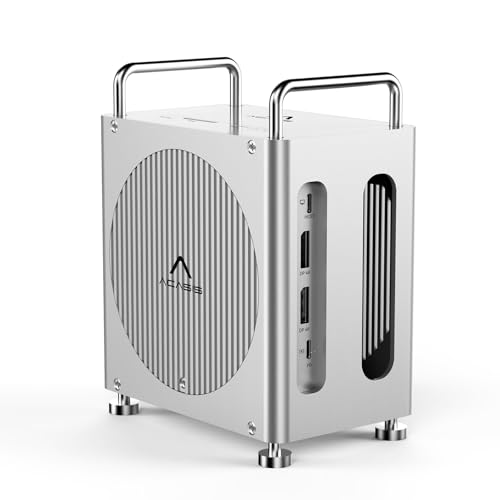
For Mac mini M4/M4 Pro users who need high-speed storage and multi-display flexibility, the ACASIS 11-in-1 Docking Station doubles as a dual NVMe enclosure and a 40Gbps hub that keeps your workflow snappy. You get dual M.2 slots (20Gbps each) that can RAID 0 to reach roughly 40Gbps, RAID 1, JBOD, or default modes, up to 16TB. Dual DisplayPort outputs support single 4K@144Hz or dual 4K@60Hz, and three USB-A 10Gbps ports plus SD/TF 4.0 readers broaden connectivity. Note shared bandwidth may lower RAID 0 speeds when driving dual displays. It includes 30W PD and a 1-year warranty.
Best For: Mac mini M4/M4 Pro users who need a compact, high-speed docking hub with dual NVMe storage and multi-display support for tasks like 4K video editing, 3D work, and heavy multitasking.
Pros:
- Provides 40Gbps host connectivity with dual M.2 slots (20Gbps each) that can RAID 0 to ~40Gbps for very fast storage performance.
- Dual DisplayPort outputs support single 4K@144Hz or dual 4K@60Hz, plus three USB-A 10Gbps ports and SD/TF 4.0 readers for expanded connectivity.
- Integrated dual-bay NVMe enclosure (RAID 0/1/JBOD/default), up to 16TB, with SSD status indicators and a compact stand form factor.
Cons:
- Shared bandwidth between displays and SSDs can reduce RAID 0 speeds when driving dual DisplayPort monitors.
- Only 30W PD—may not provide full power for some high-power peripherals or atypical setups.
- Limited to a 1-year warranty (plus standard returns) which may be short for heavy professional use.
Thunderbolt 3 to 2 PCIe Expansion Chassis with Dual PCIe Slots (MK-T2Ls)
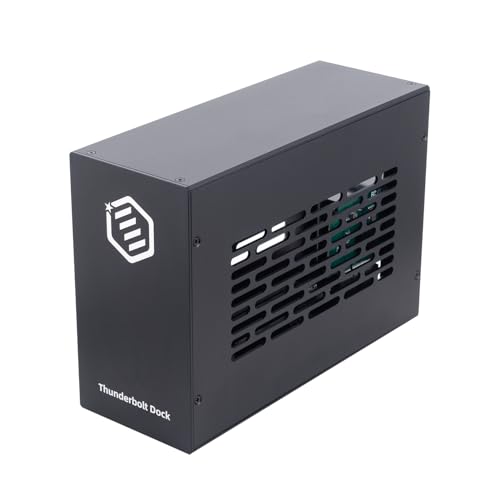
Designed for professionals who need dual full‑length PCIe cards on a compact setup, the MK‑T2Ls gives you two PCIe 3.0 x16 slots over Thunderbolt 3 so you can run DeckLink capture cards, 10GbE adapters, NVMe storage, or pro audio interfaces simultaneously. You get full 40Gbps Thunderbolt bandwidth and DisplayPort 1.4 output, so high‑bandwidth video and networking workflows remain smooth. The aluminum chassis offers solid thermal mass while a passive cooling design keeps noise absent. A 60W external supply plus 15W Power Delivery per Thunderbolt port guarantees stable operation and even reverse charging for connected devices.
Best For: Professionals and creatives who need to run two full‑length, high‑bandwidth PCIe cards (e.g., DeckLink capture cards, 10GbE adapters, NVMes, pro audio) from a laptop or compact desktop via Thunderbolt 3.
Pros:
- Dual PCIe 3.0 x16 slots over 40Gbps Thunderbolt 3 enable simultaneous high‑bandwidth cards for video, networking, and storage workflows.
- All‑aluminum chassis with passive cooling provides solid thermal performance and silent operation.
- Includes DisplayPort 1.4 and power features (60W supply + 15W PD per Thunderbolt port) for stable operation and device charging.
Cons:
- 60W external power may limit extremely power‑hungry dual card setups compared with larger eGPU‑class enclosures.
- Passive cooling may be insufficient for sustained maximum loads in very hot environments or with particularly hot cards.
- Requires Thunderbolt 3 host — not compatible with plain USB‑C or older/unsupported systems without an adapter.
Thunderbolt 3 to PCIe Expansion Chassis with Dual PCIe Slots (MK-Q2L)

If you need to add two full-size PCIe cards to a Mac Mini without opening it up, the MK-Q2L gives you dual x16 slots over a 40Gbps Thunderbolt 3 link so you can run a GPU plus a capture or network card simultaneously. You’ll plug into Thunderbolt 3/4 or USB4 and get two PCIe 3.0 x16 bays, compatible with capture cards, network adapters, or NVMe solutions. The all-aluminum chassis uses passive cooling, fits cards up to 205x25x145mm, and includes a 60W adapter with an 8-pin cable delivering up to 30W to cards. It’s plug-and-play across major OSes.
Best For: Users who need to add two full-size PCIe cards (GPU + capture/network/NVMe) to a Thunderbolt 3/4 or USB4-equipped laptop or Mac Mini without opening the host.
Pros:
- Adds two full-size PCIe 3.0 x16 slots over a 40Gbps Thunderbolt link, enabling simultaneous GPU and peripheral cards.
- Durable all-aluminum, passively cooled chassis that fits a wide range of card sizes (up to 205 x 25 x 145 mm).
- Plug-and-play across Windows, macOS, and Linux with included 60W adapter and 8-pin cable providing up to 30W to cards.
Cons:
- Thunderbolt 3’s 40Gbps shared bandwidth can limit performance when both slots are heavily used (especially for high-end GPUs).
- 60W power adapter and 30W available to cards may be insufficient for power-hungry GPUs without additional external power solutions.
- Passive cooling may be less effective for very high-heat cards under sustained heavy load.
Mac mini M4 Dock and Hub Stand with 4TB M.2 SSD Enclosure (SSD Not Included)

Gamers and creative pros who need a compact, all-in-one solution will like the Mac mini M4 Dock and Hub Stand with 4TB M.2 SSD enclosure, since it combines a sturdy mount, full-featured USB‑C dock, and high-speed NVMe storage expansion (SSD sold separately). You get 4K@60Hz HDMI, a 10Gbps USB‑C host port, three USB‑A 2.0 ports for data (no charging), SD/microSD readers, and a 3.5mm audio/mic jack. It supports dual displays via SST or MST and fits 2242/2260/2280 PCIe NVMe drives up to 4TB (format to exFAT or APFS). Aluminum build, anti‑slip pads, and Mac mini M4 compatibility guarantee stable, neat integration.
Best For: Gamers and creative professionals who want a compact, all‑in‑one mount and USB‑C dock for their Mac mini M4 with optional high‑speed NVMe storage expansion.
Pros:
- Combines a sturdy Mac mini M4 mount with a full-featured dock (4K@60Hz HDMI, 10Gbps USB‑C host, SD/microSD, audio jack) for a clean desktop setup.
- Supports up to 4TB PCIe M.2 NVMe (2242/2260/2280) at 10Gbps for fast local storage expansion (SSD not included; format to exFAT or APFS).
- Aluminum construction with anti‑slip ring and silicone pads for stable, neat integration and reduced Wi‑Fi/Bluetooth interference via USB‑A 2.0 ports.
Cons:
- SSD not included and SATA M.2 drives are not supported, so you must purchase a compatible NVMe SSD separately.
- USB‑A ports are only 2.0 (480Mbps) and provide data only — no high‑speed USB‑A or charging capabilities.
- Dual‑monitor support depends on SST/MST compatibility of your monitors and host, which may limit multi‑display configurations.
Factors to Consider When Choosing Mac Mini External Gpu Enclosures
When picking an eGPU for your Mac mini, you’ll want to check Thunderbolt compatibility first so you avoid bandwidth or driver issues. Make sure the enclosure fits your GPU’s form factor, provides adequate power delivery, and has effective cooling to prevent thermal throttling. Also confirm the ports and connectivity match your peripherals and workflow.
Compatibility With Thunderbolt
Although Thunderbolt versions can be confusing, you’ll want to confirm your Mac mini and prospective eGPU enclosure both support Thunderbolt 3, Thunderbolt 4, or USB4 to guarantee the bandwidth and compatibility you need. Check your Mac’s spec and the enclosure listing for explicit Thunderbolt/USB4 support and multiple ports for daisy chaining. Verify your CPU — Intel 8th gen+ is ideal, and on AMD systems confirm Thunderbolt or USB4 shows in Device Manager — since platform support affects functionality. Also confirm the enclosure’s power delivery rating; models that provide charging while running simplify mobile setups. Prioritize enclosures that state Thunderbolt compatibility and offer sufficient PD and port count to match your workflow and peripherals.
GPU Form Factor Support
1 key check for any Mac mini eGPU is whether the enclosure supports your card’s form factor—most high-performance GPUs use a PCIe x16 connection, but you should also verify the enclosure’s internal length, height (dual- or triple-slot), and bracket layout to be sure the card will physically fit. You’ll need to measure the GPU’s PCB length, cooler overhang, and slot width against the enclosure specs. Confirm the enclosure provides the correct power cables and connector types for your card, and that its cooling arrangement—fan placement, airflow path, radiator clearance—matches the GPU’s thermal profile. Finally, make sure the enclosure uses Thunderbolt 3 or 4 so you get the bandwidth your card requires when hooked to the Mac mini.
Power Delivery Options
Because your Mac mini setup may include laptops, peripherals, and a high-power GPU, check an enclosure’s power delivery carefully so nothing underpowers or destabilizes the system. You’ll want PD support that matches your devices—some enclosures offer 30W to 96W—so your laptop charges while the GPU runs. Verify the enclosure’s PSU type (ATX, SFX, DC) fits the GPU and any extra gear, and confirm combined wattage covers peak loads. Prioritize stable rails and robust connectors to reduce disconnects during intensive workloads; insufficient PD can throttle GPU performance. Multiple output ports are handy if you charge several devices simultaneously, but don’t assume total PD equals usable power—check per-port limits and shared-power behavior.
Cooling and Airflow Design
Heat management matters: a well-designed cooling and airflow system keeps your external GPU running at peak speeds and prevents thermal throttling or long-term damage. You’ll want an enclosure with front-to-back airflow so cool air is drawn in and hot air is expelled efficiently, which helps sustain performance during long gaming or editing sessions. Look for silent cooling fans and sizable heat sinks; they lower operating temperatures without adding distracting noise. Verify the case has adequate ventilation—strategically placed vents promote internal circulation and extend component lifespan. Good thermal design not only prevents overheating but also lets the GPU maintain higher clocks for longer, giving you more consistent frame rates and faster renders. Prioritize proven cooling over flashy looks.
Connectivity and Ports
Connectivity and ports determine how well an eGPU enclosure will integrate with your Mac Mini and peripherals, so make certain it supports Thunderbolt 3, 4, or USB4 for full bandwidth and compatibility. Beyond that, choose enclosures with extra ports—USB-A, additional Thunderbolt/USB-C—so you can plug monitors, storage, and input devices without losing Mac Mini ports. Verify power delivery specs to ascertain the enclosure can feed high-performance GPUs and, if needed, the Mac Mini. Check maximum supported PCIe card dimensions to confirm your GPU fits physically. Finally, prefer enclosures that support Thunderbolt daisy chaining so you can link displays and drives through a single port and keep your desk tidy while maintaining workflow flexibility.
Build Quality and Size
When you pick an eGPU enclosure, pay close attention to build quality and size since a sturdy aluminum chassis usually gives better cooling and longer life than plastic, while the enclosure’s footprint needs to fit your desk and any travel plans. Choose aluminum for improved thermal dissipation and rigidity; it helps keep temperatures down and components protected. Confirm dimensions so the unit sits comfortably beside your Mac Mini and clears any shelves or cases. If you travel, prioritize compact, lightweight designs with shock-absorbing features to protect the GPU and connectors. Also verify internal clearance for the specific GPU you plan to use and that the case layout promotes unobstructed airflow, since overheating will degrade performance and shorten the enclosure’s lifespan.
Driver and OS Support
Although macOS and Windows handle external GPUs differently, you should confirm OS compatibility before buying an enclosure so you don’t get stuck with hardware your Mac Mini can’t use. Check that the enclosure supports the macOS or Windows version you plan to run; some models only work with specific releases. Verify driver availability for the GPU you’ll install, since up-to-date drivers are essential for performance and stability. Prefer enclosures offering plug-and-play functionality to minimize setup and driver headaches. Make sure the enclosure’s firmware is compatible with your Mac Mini and can be updated if needed. Finally, confirm that the software you use (games, creative apps, compute tools) supports the GPU driver versions and system configuration you intend to run.
Noise and Thermal Management
Because an external GPU enclosure’s cooling makes or breaks performance and comfort, you should weigh noise and thermal management carefully before buying. You’ll find passive designs that run silently but may struggle under sustained loads, and active designs with fans that can become audible during heavy use. Prioritize enclosures with strong airflow, heat-dissipating features, and aluminum construction—metal helps pull heat away from the GPU and improves durability. Look for models that advertise low-decibel or “silent” fans; they balance cooling efficiency with a quieter workspace. Remember high temperatures throttle performance and shorten component life, so don’t sacrifice cooling for silence. Choose an enclosure that matches your typical workload intensity and tolerance for background noise.