Finding problems inside engines, HVAC systems, transmission housings, and other confined spaces is easier with the right inspection camera. The best commercial-grade automotive inspection cameras combine a durable probe, useful articulation, bright lighting, and a display that keeps diagnostic work efficient.
This roundup compares 10 practical options for mechanics, technicians, inspectors, and serious DIY users. We focus on image quality, probe control, camera versatility, durability, and the features that matter most in real automotive work.
Best 10 Commercial-Grade Automotive Inspection Cameras Picks for 2026
Long-Reach Workhorse
Teslong Dual-Lens 16.5FT Borescope

- Forward and side cameras with independent LEDs
- 16.5-foot semi-rigid cable for deep inspections
- 5-inch IPS display and IP67 waterproof probe
Best For: Long-reach automotive, HVAC, plumbing, and wall inspections
Corner-Cutting Specialist
ROVE RS2 Articulating Borescope

- Slim 6.2mm probe reaches narrow openings
- 210-degree articulation helps view around bends
- 1080p capture with included 32GB microSD card
Best For: Tight automotive spaces, engine work, and recorded inspections
Compact Articulating Pick

- Two-way 210-degree articulation for confined spaces
- 1080p capture with 2MP still images and 32GB storage
- One-handed joystick control and 4.5-inch IPS display
Best For: Portable automotive, HVAC, and wall inspections
Dual-Lens Precision Tool
FOXWELL FY406D Elite Articulating Borescope
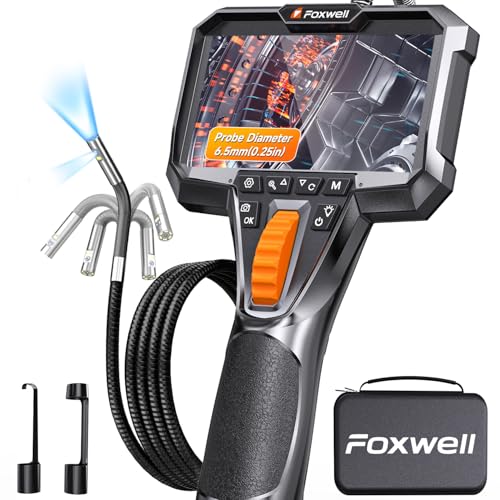
- Slim 6.5mm dual-lens probe for narrow access
- 220-degree articulation with front and side viewing
- 32GB onboard storage for photos and videos
Best For: Professional automotive, plumbing, and HVAC diagnostics
Autel-Compatible Clarity

- 1920p, 2MP imaging with eight LEDs
- 39.5-inch semi-rigid 8.5mm probe
- Compatible with listed Autel scanners and PCs
Best For: Autel-equipped technicians performing routine engine and confined-space inspections
Dual-Lens Articulation

- Articulating probe with 90-degree side camera
- 5-inch 1080p IPS display and 10X zoom
- IP67 protection with four-to-five-hour battery
Best For: Complex automotive and HVAC inspections requiring directional control
Long-Reach Steering Probe
AGC430N 220° Articulating Borescope

- 5.5-foot probe with 220-degree articulation
- 1080p imaging, 8X zoom, and adjustable LEDs
- IP67 oil-resistant design with useful accessories
Best For: Mechanics needing extended reach around automotive obstacles
Best Dual-Lens Control
Teslong Articulating Borescope

- Front- and side-view lenses simplify tight inspections
- 5-foot semi-rigid cable with two-way articulation
- 4.5-inch IPS display with adjustable LED lighting
Best For: Technicians needing flexible dual-angle automotive inspections
Best Four-Way Articulation
VEVOR 1080P Industrial Borescope
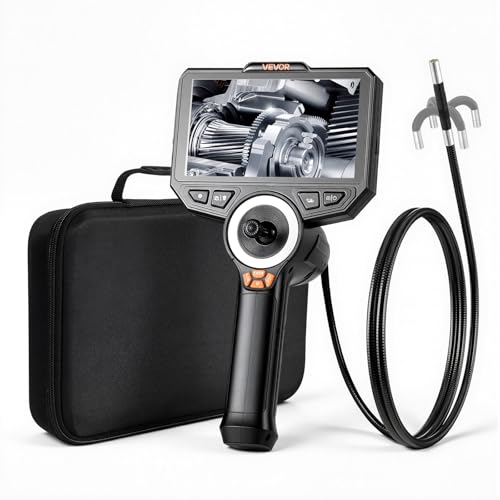
- Four-way articulation provides broad directional coverage
- True 1080p camera with a large 6-inch IPS screen
- IP67 probe and 5–6-hour battery rating
Best For: Professional automotive and industrial inspections
Best Complete Inspection Kit

- Two-way articulation with front and side cameras
- 1080p capture, IPS screen, and eight adjustable LEDs
- Includes 32GB card, case, and retrieval accessories
Best For: Versatile automotive repair and maintenance inspections
Long-Reach Workhorse – Teslong Dual-Lens 16.5FT Borescope
For commercial-grade automotive inspection cameras that can also handle ducts, walls, and plumbing, the Teslong NTS300 offers unusually long reach and dual-camera flexibility. Its 5-inch IPS display, semi-rigid 16.5-foot cable, and IP67 probe make it a practical choice for inspecting deep engine bays and other confined areas without a phone or app.
Best For: Mechanics, HVAC technicians, and property inspectors who need long cable reach and forward/side viewing.
Pros:
- Forward and side cameras provide two viewing angles, each with independent LEDs.
- Long 16.5-foot semi-rigid cable reaches deep ducts, drains, and engine compartments.
- 5-inch IPS screen, adjustable seven-LED lighting, IP67 probe, and included carrying case.
- Built-in 5000mAh battery provides approximately 4.5 hours of use.
Cons:
- Its 8mm probe is larger than ultra-slim articulating models.
- Charging takes approximately five hours.
- Video capture is listed at 720p.
The NTS300 is strongest when reach and straightforward operation matter more than compact probe size or maximum image resolution. The self-contained design and included accessories make it a versatile inspection tool for mixed automotive and maintenance work.
Corner-Cutting Specialist – ROVE RS2 Articulating Borescope
The ROVE RS2 is a strong option among commercial-grade automotive inspection cameras when access is the main challenge. Its slim 6.2mm probe, 210-degree two-way articulation, 1080p recording, and built-in display help mechanics inspect spark plug holes, cylinders, and other tight spaces without major disassembly.
Best For: Automotive technicians and DIYers who need a slim, maneuverable probe with documented photo and video capture.
Pros:
- 6.2mm waterproof probe fits narrower openings than many 8mm scopes.
- Two-way 210-degree articulation helps navigate bends and inspect around corners.
- Captures 1080p photos, video, and audio with 2x/4x zoom.
- Includes a 32GB microSD card and offers up to four hours of battery life.
Cons:
- The 1.6m cable is substantially shorter than long-reach alternatives.
- Tip articulation is two-way; full directional coverage requires rotating the probe by hand.
- The 4.3-inch display is smaller than some competing models.
Choose the RS2 when slim access, articulation, and useful inspection records are more important than maximum cable length. Its no-app workflow and included storage also suit busy shop environments where findings need to be saved and shared.
Compact Articulating Pick – Teslong 210° HD Borescope
For buyers seeking commercial-grade automotive inspection cameras with simple controls and a compact form, this Teslong articulating borescope combines a 210-degree two-way probe with a 4.5-inch IPS screen. Its 1080p capture, adjustable probe lighting, IP67 waterproofing, and semi-rigid cable support automotive, HVAC, and household inspections.
Best For: Mechanics and mobile inspectors who want one-handed control, on-device viewing, and flexible access in confined areas.
Pros:
- Two-way 210-degree articulation improves maneuverability in complex spaces.
- 4.5-inch IPS display provides sharp viewing without requiring an app.
- 1080p video, 2MP still images, 32GB storage, and IP67 waterproofing.
- Centrally positioned joystick and rear photo button support one-handed operation.
Cons:
- The 5-foot cable offers less reach than long-cable inspection cameras.
- Two-way articulation may require manual probe rotation for complete coverage.
- The supplied notes do not specify the probe diameter.
This model is a practical middle ground for routine engine, HVAC, and wall inspections. It emphasizes portability and control rather than extended reach, making it well suited to technicians who regularly work close to the inspection point.
Dual-Lens Precision Tool – FOXWELL FY406D Elite Articulating Borescope
The FOXWELL FY406D Elite stands out among commercial-grade automotive inspection cameras for combining a slim 6.5mm probe, 220-degree articulation, and dual-lens coverage. Switching between front and side cameras can help inspect cylinders, valves, and narrow passages while reducing the need for disassembly.
Best For: Automotive, plumbing, and HVAC professionals who need slim access, side-view coverage, and onboard recording.
Pros:
- 6.5mm probe fits spark plug holes, vents, and narrow pipes.
- Dual front and side cameras provide broader coverage in complex spaces.
- 220-degree articulation and adjustable LEDs improve positioning and visibility.
- Built-in 32GB storage supports photo and video capture without Wi-Fi or an app.
Cons:
- The supplied notes do not specify screen size or video resolution.
- Its heat-protection system may shut the device down above 70°C.
- It requires one AAA battery according to the listed battery details.
The FY406D Elite is a compelling choice when probe access and viewing angle are priorities. Its dual-lens design and onboard storage are particularly useful for diagnosing narrow automotive spaces and documenting findings on the job.
Autel-Compatible Clarity – MaxiVideo MV108S
For technicians seeking commercial-grade automotive inspection cameras that work with existing Autel diagnostic equipment, the MV108S is a practical, plug-and-play option. Its upgraded 2MP sensor, 1920p video, eight LEDs, and slim 8.5mm probe help reveal faults in dark, confined areas.
Best For: Autel scanner owners inspecting engines, cylinders, pipes, and other tight spaces.
Pros:
- 1920p video and 2MP imaging provide clearer detail than the older MV108.
- 39.5-inch semi-rigid cable holds its shape for controlled positioning.
- IP67 waterproof design supports wet inspections, including limited underwater use.
- Works with listed Autel scanners and PCs without Wi-Fi or Bluetooth.
Cons:
- Compatibility is centered on Autel scanners and USB-equipped PCs.
- The probe is non-articulating, so positioning depends on bending and guiding the cable.
- The 8.5mm camera may not fit the very narrowest passages.
The MV108S makes the most sense when Autel compatibility and straightforward image capture matter more than built-in articulation. It is a capable choice for routine automotive diagnosis and general inspection work.
Dual-Lens Articulation – AGC500L Dual-Lens Borescope
The AGC500L is built for commercial-grade automotive inspection cameras users who need to steer around obstacles and view hard-to-reach surfaces. Its articulating probe, side camera, 5-inch 1080p display, and 10X zoom make detailed inspections easier without relying on a phone or app.
Best For: Mechanics inspecting engine interiors, turbochargers, gearboxes, HVAC paths, and other complex assemblies.
Pros:
- Articulating probe and 90-degree side camera help reduce blind spots.
- Large 5-inch 1080p IPS screen supports easier detail viewing.
- IP67 waterproof and oil-proof design suits demanding inspection environments.
- 3000mAh rechargeable battery provides approximately four to five hours of use.
Cons:
- The 5-inch display and accessories make it less compact than a basic USB scope.
- Its listed 1–15cm macro focus range favors close-up work rather than distant viewing.
- Dual-lens articulation adds controls that may require a short learning period.
Choose the AGC500L when directional control and a broader view are priorities. The side camera and articulating tip are particularly useful when a straight probe cannot easily face the inspection target.
Long-Reach Steering Probe – AGC430N 220° Articulating Borescope
For commercial-grade automotive inspection cameras that need reach and directional flexibility, the AGC430N combines a 5.5-foot probe with two-way 220-degree articulation. Its 8.5mm 2MP camera, adjustable LEDs, and built-in monitor are suited to close-up automotive troubleshooting without an app.
Best For: Mechanics checking cylinders, valves, pistons, spark plugs, diesel systems, HVAC lines, and other extended or obstructed spaces.
Pros:
- Two-way 220-degree steering helps navigate turns and look behind obstacles.
- 5.5-foot probe offers more reach for larger or deeper systems.
- 1080p output, 8X digital zoom, and adjustable LED brightness support close inspection.
- IP67 waterproof, oil-resistant construction and included hook, magnet, and mirror add versatility.
Cons:
- The 4.3-inch monitor is smaller than the AGC500L’s 5-inch screen.
- Its longer probe may be less convenient for very short, simple inspections.
- Digital zoom can enlarge an image without adding optical detail.
The AGC430N is a strong fit when probe length and articulation are more important than maximum portability. Its standalone monitor and included retrieval accessories make it practical for field repairs and difficult engine access.
Best Dual-Lens Control – Teslong Articulating Borescope
For commercial-grade automotive inspection cameras that prioritize viewing flexibility, the Teslong Articulating Borescope combines front- and side-view lenses with two-way articulation. Its built-in screen, semi-rigid cable, and adjustable lighting make it practical for examining engines, HVAC systems, walls, and other confined areas without relying on a phone app.
Best For: Mechanics and maintenance professionals who need dual-angle visibility and one-handed control in tight spaces.
Pros:
- Dual front- and side-view cameras reduce the need to reposition the probe.
- Two-way articulation and a 5-foot semi-rigid cable provide controlled maneuvering.
- 4.5-inch IPS screen and adjustable high-brightness LEDs support inspections in varied lighting.
- Includes photo and video capture, USB-C connectivity, and a carrying case.
Cons:
- Video capture is listed at 720p, below the resolution of some newer inspection cameras.
- The two-way articulation offers less directional control than four-way designs.
- At 1.44 kg, it may feel substantial during prolonged handheld inspections.
The Teslong is a strong choice when switching between forward and side views is more useful than maximizing resolution. Its ergonomic joystick and no-app operation also suit technicians who want a self-contained inspection tool.
Best Four-Way Articulation – VEVOR 1080P Industrial Borescope
Among commercial-grade automotive inspection cameras, the VEVOR 4-Way Articulating Endoscope stands out for directional control and display size. Its true 1080p camera, 6-inch IPS screen, slim probe, and IP67-rated waterproof construction are suited to detailed inspections in engines, mechanical systems, drains, and other demanding environments.
Best For: Automotive and industrial users who need broad probe control, high-resolution imaging, and extended cordless operation.
Pros:
- Four-way articulation helps provide coverage from multiple angles without twisting the scope.
- True 1080p video and a 6-inch IPS screen support detailed viewing.
- The 0.24-inch camera head can reach narrow spaces.
- IP67 waterproofing and a 7000mAh battery rated for 5–6 hours support demanding work sessions.
Cons:
- At 2.5 pounds, it is heavier than some compact inspection cameras.
- The 4.9-foot probe is slightly shorter than five-foot alternatives.
- Its larger screen and four-way mechanism may be more equipment than needed for occasional basic checks.
The VEVOR is the most control-focused option in this group. It makes particular sense for professional inspections where viewing angle, narrow access, waterproofing, and all-day battery capacity matter more than minimizing size.
Best Complete Inspection Kit – Acoath Dual-Lens Borescope
For buyers seeking commercial-grade automotive inspection cameras with useful accessories, the Acoath Two-Way Articulating Borescope offers dual-lens viewing, 1080p capture, and a practical kit. Its 5-foot semi-rigid cable, slim probe, IP67 rating, and included hooks, magnet, mirror, and protective case make it ready for varied repair and maintenance tasks.
Best For: Automotive technicians and hands-on users who want a versatile dual-lens scope with accessories and a compact standalone display.
Pros:
- Two-way 210-degree articulation and front/side lenses help inspect difficult angles.
- 1080p imaging, a 4.3-inch IPS screen, and eight adjustable LEDs support clear viewing.
- IP67 waterproofing and a slim 0.33-inch probe suit wet and confined areas.
- Includes a 32GB card, protective case, magnet, hook, mirror, and protective cap.
Cons:
- Two-way articulation provides less directional coverage than a four-way design.
- The 4.3-inch display is smaller than the VEVOR’s 6-inch screen.
- The listed video capture format is AVI, while the product details also reference MP4 file support, so buyers should confirm the preferred recording format.
The Acoath balances image quality, portability, and included accessories well. It is a sensible pick for technicians who want a self-contained scope for automotive, HVAC, pipe, and mechanical inspections without adding separate tools.
How We Picked the Best Commercial-Grade Automotive Inspection Cameras
We evaluated these cameras around the demands of automotive diagnosis rather than headline specifications alone. Key considerations included probe diameter, articulation range, image resolution, lighting control, lens configuration, screen usability, recording features, water resistance, and overall handling.
Dual-lens models can make it easier to inspect both the forward path and the surrounding area, while articulating probes help users steer around bends and position the camera precisely. We also considered whether each design suits repeated workshop use, mobile diagnostics, or occasional home and vehicle inspections.
Quick Comparison
For the broadest coverage, look for a dual-lens camera with a flexible, articulating probe. A built-in IPS screen is convenient when you do not want to connect a phone, while USB models can be useful when a larger device or computer-based viewing is preferred. Models with onboard storage are better suited to documenting findings for customers, estimates, or service records.
Key Buying Factors
Probe Size and Articulation
A narrow probe reaches more openings, but a slightly larger probe may provide a sturdier cable and better image hardware. Two-way or four-way articulation gives more control than a fixed or simply flexible cable, especially inside engines and HVAC ducts.
Image Quality and Lighting
Resolution matters, but lighting and lens placement matter just as much in dark mechanical spaces. Choose adjustable LEDs and a camera that maintains a clear image close to oily, reflective, or uneven surfaces. Dual-lens designs add flexibility when the forward view is obstructed.
Durability and Protection
For workshop use, prioritize a probe with IP-rated protection, a robust cable, sealed controls, and a screen that is easy to hold with gloves. Waterproofing does not make every component suitable for immersion, so follow the manufacturer’s limits.
Recording and Power
Photo and video capture helps document defects and explain recommended repairs. Check storage capacity, file transfer options, battery runtime, charging method, and whether the camera can continue operating during extended inspections.
Who Should Buy Which Commercial-Grade Automotive Inspection Cameras?
Professional mechanics and fleet technicians should favor articulating, dual-lens models with strong lighting, onboard recording, and a durable display. These features reduce repositioning and make findings easier to document.
HVAC and building-service technicians may benefit most from a slim probe with reliable articulation and a flexible cable for navigating ducts, wall cavities, and equipment compartments. Mobile inspectors should prioritize compact storage, a built-in screen, and long battery life.
DIY users who perform occasional repairs can save money with a simpler 1080p model, provided it has adequate lighting, a sufficiently narrow probe, and a comfortable viewing interface. If you regularly inspect several vehicle systems, upgrading to a dual-lens articulating camera is usually worthwhile for the added reach and situational awareness.