A mini PC can make a tidy Blender workstation, but compact size comes with trade-offs. The right choice depends on whether you mainly model and preview scenes or expect to render complex animations for hours.
These 10 picks span entry-level systems and higher-spec machines. Use the guide below to match CPU, memory, graphics, and upgrade options to the work you actually do.
Best 10 Mini PC for Blender Rendering Picks for 2026
Compact All-Rounder

- 8-core, 16-thread Ryzen processor
- Radeon 780M integrated graphics
- Triple 4K display support
Best For: Modest Blender projects and everyday creative work
Memory-Expandable Pick
GMKtec M6 Ultra Ryzen 5 7640HS

- 32GB dual-channel DDR5 installed
- RAM expandable up to a stated 128GB
- Dual M.2 slots and USB4
Best For: Memory-conscious Blender users who want upgrade options
External-GPU Path

- OCuLink port for an eGPU setup
- 6-core, 12-thread Ryzen processor
- Dual M.2 slots and dual 2.5GbE LAN
Best For: Planning a compact Blender setup with an external GPU
High-Core-Count Choice

- 12-core, 24-thread Ryzen AI 9 HX 370
- 32GB DDR5 RAM and 1TB SSD
- OCuLink plus three SSD slots
Best For: CPU-focused Blender work with room to expand
Best for Expandable Workflows
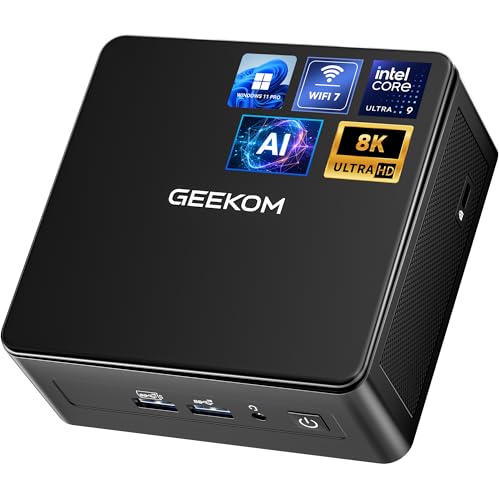
- Core Ultra 9 285H with Arc 140T graphics
- 32GB DDR5 RAM, upgradeable to 128GB
- Two USB4 ports support external GPUs
Best For: Compact Blender setups with an external-GPU upgrade path
Best for Learning Blender

- Six-core, 12-thread Ryzen 5 6600H
- 16GB LPDDR5 RAM; listed maximum is 16GB
- Triple-display support for a compact workspace
Best For: Beginners working on smaller Blender projects
Best for Larger Projects
GEEKOM A9 Max AI Boost Mini PC

- 12-core, 24-thread Ryzen AI 9 HX 370
- 32GB DDR5 RAM, expandable to 128GB
- 2TB SSD with dual Gen4 storage slots
Best For: Blender users who need more CPU, RAM, and storage headroom
Compact Creator Pick
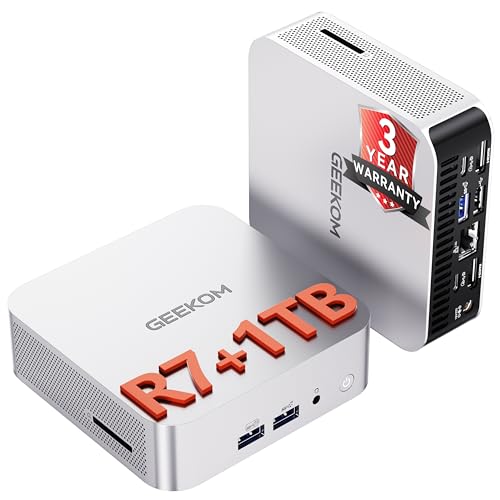
- Eight-core Ryzen 7 8745HS
- Upgradeable DDR5 and 1TB PCIe 4.0 SSD
- 0.5-liter chassis with VESA mount
Best For: Compact modeling and smaller Blender projects
eGPU Expansion Pick

- Eight-core Ryzen 7 8745HS
- Two USB4 ports with stated eGPU support
- Three selectable operating modes
Best For: Blender setups planning for external graphics
CPU-Focused Starter Pick
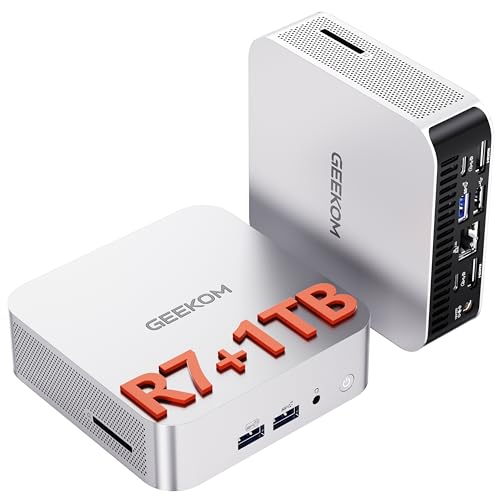
- 45W-rated Ryzen 7 6800H
- Dual-slot DDR5 upgradeable to 64GB
- 1TB PCIe Gen 4 SSD and USB4
Best For: Smaller Blender scenes and CPU-oriented work
Compact All-Rounder – ACEMAGICIAN S3A Ryzen 7 H 255
If you want a mini pc for blender rendering that also serves as an everyday creative workstation, the ACEMAGICIAN S3A pairs an 8-core, 16-thread Ryzen 7 H 255 with Radeon 780M integrated graphics. Its 16GB of memory and 512GB SSD make it a practical starting point for smaller Blender projects.
Best For: Creators working on modest scenes who also want a compact, multi-display desktop.
Pros:
- 8-core, 16-thread processor offers useful CPU capacity for rendering and multitasking.
- HDMI, DisplayPort, and USB4 support up to three 4K displays.
- Three power modes and dual-fan cooling let you tailor the system to the workload.
Cons:
- 16GB RAM may be restrictive for complex scenes; the notes describe storage expansion, not a RAM upgrade.
- Radeon 780M is integrated graphics, not a dedicated rendering GPU.
The S3A makes the most sense when desk space and general-purpose performance matter alongside Blender. For demanding GPU renders or large scenes, its integrated graphics and memory capacity are important limits to weigh.
The GMKtec M6 Ultra is a mini pc for blender rendering buyers who prioritize working memory and upgrade options over a dedicated GPU. It ships with 32GB of dual-channel DDR5 RAM, a 6-core, 12-thread Ryzen 5 7640HS, and Radeon 760M integrated graphics.
Best For: Blender users who want 32GB of RAM out of the box and room to expand memory and storage.
Pros:
- 32GB installed DDR5 RAM is useful when juggling scenes and other applications.
- SO-DIMM memory supports expansion up to a stated 128GB.
- Two M.2 slots provide storage expansion for project files and assets.
- USB4, triple-display support, and dual 2.5GbE LAN suit a connected workstation.
Cons:
- The 6-core CPU has fewer cores than some other options in this roundup.
- Radeon 760M integrated graphics are a limitation if fast GPU rendering is the priority.
Its strongest Blender-related advantage is the installed 32GB RAM, particularly if you keep reference material and other tools open while working. Check the specifications carefully before planning a storage upgrade, as the supplied notes give differing maximum-capacity figures.
If an external graphics setup is in your plans, the GMKtec M8 is a mini pc for blender rendering worth considering for its OCuLink port. On its own, it combines a 6-core, 12-thread Ryzen 5 PRO 6650H, Radeon 660M integrated graphics, 16GB LPDDR5 RAM, and a 512GB SSD.
Best For: Buyers who want a compact Blender workstation with an OCuLink connection for a future eGPU setup.
Pros:
- OCuLink provides a direct connection option for an external GPU.
- Two M.2 slots support additional storage for projects and assets.
- USB4, dual 2.5GbE LAN, and triple-display support add workstation flexibility.
Cons:
- An external GPU is not included; the built-in Radeon 660M remains integrated graphics.
- The supplied notes specify 16GB LPDDR5 RAM but do not describe a RAM upgrade path.
The M8 stands out for its connection options rather than its out-of-box graphics power. It is a more compelling choice if you intend to build around OCuLink than if you need strong GPU rendering performance immediately.
For a mini pc for blender rendering with more CPU cores and installed storage, the MINISFORUM AI X1 Pro-370 offers a 12-core, 24-thread Ryzen AI 9 HX 370, Radeon 890M integrated graphics, 32GB DDR5 RAM, and a 1TB PCIe 4.0 SSD. Its OCuLink port also leaves an option for an external GPU setup.
Best For: Creators seeking a higher-core-count compact system with 32GB RAM and a potential eGPU path.
Pros:
- 12-core, 24-thread processor is a strong fit on paper for CPU-heavy workloads.
- 32GB removable DDR5 RAM supports a stated upgrade to 128GB.
- Three PCIe 4.0 SSD slots offer room for project-storage expansion.
- OCuLink, dual USB4, and four-display support suit an expandable workstation.
Cons:
- The Radeon 890M is integrated graphics; an external GPU would require additional hardware.
- The stated full-load noise level can reach 45dB.
This is the most CPU-focused option of the four by stated core count, with useful memory and storage headroom. Choose it for those capabilities, while treating its eGPU connectivity as an expansion option rather than included rendering performance.
Best for Expandable Workflows – GEEKOM IT15 AI Mini PC
If you want a mini pc for blender rendering that can also support a busy editing or development desk, the GEEKOM IT15 pairs an Intel Core Ultra 9 285H with 32GB of DDR5 RAM and a 1TB NVMe SSD. Its integrated Arc 140T graphics are suitable for an all-in-one setup, while two USB4 ports give you an option to connect an external GPU.
Best For: Creators who want a compact Blender workstation with memory headroom and an external-GPU upgrade path.
Pros:
- 32GB DDR5 RAM is upgradeable to 128GB for larger projects and heavier multitasking.
- Two 40Gbps USB4 ports support external GPUs and fast peripherals.
- Dual HDMI and dual USB4 ports support a four-display workspace.
Cons:
- Arc 140T is integrated graphics; demanding GPU renders may call for an external GPU.
- The advertised 99 TOPS AI figure is not a Blender render-speed benchmark.
The IT15 makes the most sense if you value a capable compact PC now and want the flexibility to expand your Blender setup later.
Best for Learning Blender – Getorli Ryzen 5 6600H Mini PC
For a mini pc for blender rendering on smaller projects, the Getorli offers a six-core, 12-thread Ryzen 5 6600H, integrated Radeon 660M graphics, 16GB of LPDDR5 memory, and a 512GB NVMe SSD. It is better suited to learning, modeling, and occasional renders than to a sustained, graphics-heavy render workload.
Best For: Blender beginners who also need a compact PC for everyday work and light creative tasks.
Pros:
- Six-core, 12-thread processor provides a useful starting point for CPU-based work.
- HDMI, DisplayPort, and Type-C outputs support three displays.
- NVMe storage can be expanded up to the stated 4TB capacity.
Cons:
- Radeon 660M is integrated graphics, limiting its appeal for demanding GPU renders.
- Installed 16GB LPDDR5 memory is also the listed maximum, leaving no RAM upgrade path.
Choose this Getorli for lighter Blender work and general productivity; if complex scenes or frequent renders are the priority, its fixed memory and integrated graphics are important limits.
Best for Larger Projects – GEEKOM A9 Max AI Boost Mini PC
If your mini pc for blender rendering needs more room for multitasking and project files, the GEEKOM A9 Max combines a 12-core, 24-thread Ryzen AI 9 HX 370 with Radeon 890M integrated graphics, 32GB of DDR5 RAM, and a 2TB SSD. Its cooling system is designed for demanding workloads, though render times will still depend on your scene and render settings.
Best For: Blender users who want a higher-spec compact PC for 3D work alongside editing and other creative tasks.
Pros:
- 12-core, 24-thread CPU and Radeon 890M graphics provide a strong integrated starting point for creative work.
- 32GB DDR5 RAM is expandable to 128GB.
- Dual PCIe Gen4 SSD slots provide storage expansion beyond the included 2TB.
Cons:
- Radeon 890M remains an integrated GPU rather than a dedicated graphics card.
- Its 80 TOPS AI rating does not indicate how quickly Blender scenes will render.
The A9 Max is the strongest fit here for users prioritizing CPU resources, memory expansion, and included storage in one small box. Check your preferred Blender rendering workflow against its integrated-GPU limitations before buying.
Compact Creator Pick – GEEKOM A8 Ryzen 7 8745HS
If you need a mini pc for blender rendering in a space-conscious setup, the GEEKOM A8 pairs an eight-core Ryzen 7 8745HS with Radeon 780M integrated graphics. It is a practical choice for modeling and lighter renders, but the supplied specifications do not establish dedicated-GPU rendering performance.
Best For: Blender users who value a compact workstation for modeling, previews, and smaller projects.
Pros:
- Eight-core, 16-thread Ryzen 7 8745HS for CPU-intensive work.
- 16GB DDR5 and 1TB PCIe 4.0 SSD, with stated upgrade support up to 128GB RAM and 4TB storage.
- 0.5-liter aluminum chassis includes a VESA mount to free desk space.
Cons:
- Radeon 780M is integrated graphics, not a dedicated rendering GPU.
- Large Blender scenes may call for more than the included 16GB RAM.
The A8 makes the most sense when footprint and upgrade flexibility matter more than maximum render speed. Budget for a memory upgrade if your projects grow.
EGPU Expansion Pick – GEEKOM AX8 Max Ryzen 7 8745HS
For buyers comparing a mini pc for blender rendering, the GEEKOM AX8 Max stands out for its two USB4 ports and stated external-GPU connectivity. Its eight-core Ryzen 7 8745HS and integrated Radeon 780M provide a starting point, while an external GPU offers a potential upgrade path rather than included rendering power.
Best For: Blender users who want a compact PC with a stated USB4 eGPU connection option.
Pros:
- Ryzen 7 8745HS with eight cores and 16 threads.
- Two USB4 40Gbps ports support an external-GPU connection.
- 16GB DDR5 and 1TB NVMe Gen 4 SSD; stated limits are 128GB RAM and 8TB storage.
- Quiet, Normal, and Performance modes offer workload-specific settings.
Cons:
- No external GPU is included; built-in graphics are Radeon 780M.
- Adding an eGPU requires extra hardware and desk space.
Choose the AX8 Max if its USB4 expansion suits your longer-term setup. For demanding Blender renders, factor the cost of external graphics into the purchase decision.
CPU-Focused Starter Pick – GEEKOM A6 Ryzen 7 6800H
The GEEKOM A6 is a mini pc for blender rendering when your priority is an eight-core Ryzen 7 6800H in a small desktop. Its 45W-rated processor and upgradeable DDR5 suit CPU-led work, while the Radeon 680M remains integrated graphics rather than a dedicated render card.
Best For: Blender beginners working on smaller scenes and prioritizing CPU capability and memory upgrades.
Pros:
- Ryzen 7 6800H is specified with a 45W TDP.
- 16GB DDR5 uses dual slots, with stated upgrade support up to 64GB.
- Includes a 1TB PCIe Gen 4 NVMe SSD.
- USB4, dual HDMI, and USB 3.2 support a flexible workspace.
Cons:
- Radeon 680M integrated graphics may be limiting for graphics-heavy Blender work.
- The included 16GB RAM may need upgrading for larger scenes.
The A6 is a sensible compact starting point for CPU-oriented Blender tasks. If fast GPU rendering is essential, compare systems with dedicated graphics before buying.
How We Picked the Best Mini PC for Blender Rendering
We compared the listed CPU core counts, integrated graphics, installed memory, storage, and stated upgrade options across the 10 selected systems. For Blender, we gave particular weight to RAM capacity and CPU capability: both affect how comfortably you can work with larger scenes, and the CPU remains a practical rendering path on these machines. We did not treat advertised AI TOPS as a Blender performance score or assume that two PCs with similar processors will sustain identical speeds. Cooling and power limits matter in small enclosures, so check independent sustained-load tests before buying for long render jobs.
Quick Comparison
For the strongest on-paper CPU options, start with the MINISFORUM AI X1 Pro-370 or GEEKOM A9 Max, both listed with a Ryzen AI 9 HX 370 and 32GB of RAM. The GEEKOM IT15 pairs an Intel Core Ultra 9 285H with 32GB. These are the clearest starting points for buyers prioritizing heavier multitasking or CPU rendering, though real-world results depend on cooling.
The GMKtec M6 Ultra also ships with 32GB, making it worth comparing if memory matters more than buying the highest-tier processor. The GEEKOM A8, AX8 Max, and A6 offer 1TB of listed storage but start at 16GB of RAM. The ACEMAGICIAN S3A, GMKtec M8, and Getorli Ryzen 5 6600H system also start at 16GB; consider scene size and upgradeability before choosing among them.
Key Buying Factors for a Mini PC for Blender Rendering
CPU and Sustained Cooling
More cores can help CPU rendering, but a mini PC’s cooling and configured power limits determine how well it holds performance through a long job. If you render regularly, look for reviews that include extended Blender CPU benchmarks, noise measurements, and temperatures rather than relying only on boost-clock claims.
RAM and Storage
For moderate or complex scenes, 32GB is a more comfortable starting point than 16GB. Check whether memory is socketed and upgradeable: LPDDR5 configurations are typically not user-replaceable. A 512GB SSD can fill quickly with assets, caches, and output files; 1TB or expandable storage offers more room.
Graphics and Render Engine
Integrated Radeon or Intel graphics can handle many modeling and viewport tasks, but they are not a substitute for a powerful discrete render GPU. Blender GPU-rendering support depends on the specific graphics hardware, driver, operating system, and Blender version. Verify current compatibility for your intended render engine before purchase; do not assume an integrated GPU will deliver fast Cycles renders.
Who Should Buy Which Mini PC for Blender Rendering?
Choose an HX 370 system with 32GB if you want the strongest listed AMD CPU specifications in this group; compare the MINISFORUM and GEEKOM configurations, storage, and tested thermals. Consider the IT15 if you prefer Intel and can find reliable Blender benchmarks for it. For a more restrained purchase, compare the 32GB GMKtec M6 Ultra against upgradeable 16GB options such as the GEEKOM A8 or A6, factoring in the cost of additional memory. A 16GB model is a better fit for learning, modeling, and lighter scenes than for demanding production renders. If fast GPU rendering is your main goal, prioritize a desktop with a supported discrete GPU instead of choosing a mini PC on integrated-graphics specifications alone.